 ChipApex | Global Electronic Components Supplier
SEARCH
Search Product
Search Post
— IC芯片 | 连接器 | 传感器 | 被动器件 —
Search productSearch post
— IC芯片 | 连接器 | 传感器 | 被动器件 —
Consult the customer manager about the wholesale price.
consultation hotline:86-132-6715-2157
email:[email protected]
Contact the product manager for consultation. One-stop consultation is available.
Do you want a lower wholesale price? Please send us your inquiry and we will reply immediately.
The MC100EP195BFAG is a 3.3 V ECL Programmable Delay Chip (PDC) designed for clock deskewing and timing adjustment in high-speed systems. It provides variable delay of differential NECL/PECL input transitions with a digitally selectable resolution of approximately 10 ps and a net programmable range up to 10.2 ns. The device features a maximum input clock frequency exceeding 1.2 GHz and operates within a supply voltage range of 3.0 V to 3.6 V for PECL mode, or -3.0 V to -3.6 V for NECL mode. It includes internal temperature compensation and supports cascading multiple units via the D10 control pin to extend the total delay range. The component is housed in an LQFP-32 package.
Verify the specific ordering suffix 'FAG' corresponds to the LQFP-32 package configuration as defined in the manufacturer's ordering information. Confirm that the procurement source provides the official datasheet revision Rev. 4 documentation to ensure accurate electrical parameter alignment. Check for lead time requirements associated with the tray packaging format specified for this suffix variant.
Select the MC100EP195BFAG when an LQFP-32 surface mount package is required for the programmable delay function. Ensure the design accommodates the necessary power supply rails for either PECL (+3.3V) or NECL (-3.3V) operation modes. Verify that the system requires the specific 10-bit address bus interface for delay selection and that the thermal resistance characteristics of the LQFP package meet the application's heat dissipation needs.
This component belongs to the MC100EP195B series of 3.3 V ECL Programmable Delay Chips. The BFAG suffix specifically denotes the LQFP-32 package variant, distinguishing it from the QFN32 package version designated by the MNG suffix. Both variants share identical electrical specifications and functional capabilities, differing only in physical footprint and pinout arrangement.
The MC100EP195BMNG serves as a direct package alternative offering identical electrical performance in a QFN32 footprint. Designers must account for the mechanical differences between LQFP-32 and QFN32 packages during PCB layout modifications.
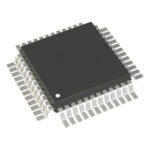 MC100EP195BFAG
The activity of extra discounts on wholesale prices is in full swing…
Please fill in your contact information and we will send you the latest wholesale price list.





