 ChipApex | Global Electronic Components Supplier
SEARCH
Search Product
Search Post
— IC芯片 | 连接器 | 传感器 | 被动器件 —
Search productSearch post
— IC芯片 | 连接器 | 传感器 | 被动器件 —
Consult the customer manager about the wholesale price.
consultation hotline:86-132-6715-2157
email:[email protected]
Contact the product manager for consultation. One-stop consultation is available.
Do you want a lower wholesale price? Please send us your inquiry and we will reply immediately.
The MC1496P1 is a balanced modulator and demodulator integrated circuit manufactured by onsemi, housed in a 14-pin PDIP package. Designed for RF applications, it operates with a maximum frequency of 300 MHz and supports FM modulation formats. The device functions as an RF IC where the output voltage represents the product of an input signal and a switching carrier function. It requires a supply current of 5 mA and is rated for operation within a temperature range extending to 70°C, with power dissipation specified at 33 mW.
Verify component authenticity through official manufacturer channels or authorized distributors due to potential availability constraints. Confirm package integrity and pin alignment against the 14-PDIP specification before integration. Review datasheet revisions for any historical manufacturing changes. Ensure thermal management aligns with the 33 mW dissipation rating during system design validation.
Select this component when balanced modulation with high carrier suppression is required for frequencies up to 300 MHz. Consider the PDIP package constraint for prototyping or specific board layout requirements. Evaluate the 5 mA supply current against system power budgets. Compare performance metrics such as common mode rejection against alternative solutions if higher frequency ranges are necessary.
The MC1496 series represents a family of balanced modulators and demodulators designed for linear multiplication of signals. Variants include SOP and DIP packages, with the MC1496P1 specifically utilizing the plastic dual in-line configuration. This component belongs to onsemi's RF and wireless portfolio, serving foundational roles in communication hardware requiring precise signal mixing and demodulation.
The MC1496BDG is a documented equivalent variant within the same product family offering similar balanced modulation functionality. Verify pin compatibility and package dimensions when substituting between PDIP and SOIC formats. Cross-reference electrical specifications to ensure operational parameters remain within acceptable limits for the target application.
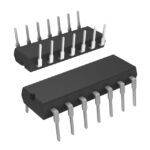 MC1496P1
The activity of extra discounts on wholesale prices is in full swing…
Please fill in your contact information and we will send you the latest wholesale price list.





