 ChipApex | Global Electronic Components Supplier

SEARCH
Search Product
Search Post
— IC芯片 | 连接器 | 传感器 | 被动器件 —
Search productSearch post
— IC芯片 | 连接器 | 传感器 | 被动器件 —
Consult the customer manager about the wholesale price.
consultation hotline:86-132-6715-2157
email:[email protected]
Contact the product manager for consultation. One-stop consultation is available.
Do you want a lower wholesale price? Please send us your inquiry and we will reply immediately.
MC74HC165AF is listed in the Shift Registers range at ChipApex. The manufacturer field lists onsemi. Its product description is IC SHIFT REGISTER 8BIT 16-SOEIAJ. Review the specifications below when checking this part for your BOM.
The MC74HC165AF is an 8-bit serial or parallel-input/serial-output shift register manufactured by onsemi. It utilizes high-performance silicon-gate CMOS technology and features a pinout identical to the LS165. The device supports asynchronous parallel loading when the Serial Shift/Parallel Load input is low, and serial shifting on the rising edge of the Clock or Clock Inhibit inputs when that control signal is high. It operates within a voltage range of 2.0 V to 6.0 V for the HC variant.
Verify the specific suffix (e.g., -Q) against project requirements, as it indicates automotive qualification and unique site controls. Confirm package type availability matches design constraints. Ensure compliance with RoHS and lead-free standards if required. Cross-reference ordering information for tape and reel specifications to match assembly equipment capabilities.
Select the HC variant for operation between 2.0 V and 6.0 V, or HCT for 4.5 V to 5.5 V applications. Consider the QFN-16 package for compact designs or SOIC/TSSOP for standard surface mount processes. Evaluate propagation delay and maximum clock frequency requirements against system timing constraints at the intended supply voltage.
This component belongs to the 74HC series of high-speed CMOS logic devices. It serves as a direct replacement for legacy LS165 parts while offering improved power consumption and noise immunity characteristics typical of modern CMOS technology. The device is part of onsemi's standard product portfolio for general-purpose logic applications.
MC74HC165A/D
When this input is low, data from the parallel inputs (A-H) is loaded asynchronously into the register. When high, data enters serially via the SA input on the rising edge of the clock.
Yes, they function identically as NOR inputs. They can combine two independent clock sources, or one can act as an inhibit signal, provided the inhibit goes high only while the clock is high to avoid double clocking.
Explore related parts through Logic, Integrated Circuits (ICs), all product categories, ChipApex homepage.
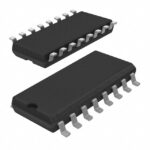 MC74HC165AF

The activity of extra discounts on wholesale prices is in full swing…
Please fill in your contact information and we will send you the latest wholesale price list.





