 ChipApex | Global Electronic Components Supplier

SEARCH
Search Product
Search Post
— IC芯片 | 连接器 | 传感器 | 被动器件 —
Search productSearch post
— IC芯片 | 连接器 | 传感器 | 被动器件 —
Consult the customer manager about the wholesale price.
consultation hotline:86-132-6715-2157
email:[email protected]
Contact the product manager for consultation. One-stop consultation is available.
Do you want a lower wholesale price? Please send us your inquiry and we will reply immediately.
MC74HC174ADR2 is listed in the Flip Flops range at ChipApex. The manufacturer field lists onsemi. Its product description is IC FLIP FLOP HEX CLOCK D 16SOIC. Review the specifications below when checking this part for your BOM.
The MC74HC174ADR2G is a Hex D-Type Flip-Flop from the onsemi 74HC series, housed in a 16-SOIC package. It features six independent D-type flip-flops with positive-edge triggering and an asynchronous active-low reset input. The device operates within a supply voltage range of 2 V to 6 V, supporting single-ended inputs and outputs. Key electrical parameters include a propagation delay of 110 ns, output current capabilities of ±5.2 mA, and a maximum clock frequency of 35 MHz at 6 V. It functions across an extended temperature range of -55°C to +125°C.
Verify the specific ordering suffix 'R2' against official onsemi documentation to confirm tape-and-reel packaging specifications. Ensure the part number matches the RoHS-compliant variant (typically ending in G) if environmental compliance is required. Cross-reference the manufacturer's latest datasheet for any pinout or electrical characteristic updates prior to final design approval.
Select this component when a hex D-type flip-flop with asynchronous reset is required in a surface-mount SOIC-16 package. Consider the 74HC series for compatibility with standard TTL logic levels while operating at lower voltages than HCT variants. Evaluate the 110 ns propagation delay and 35 MHz clock speed against system timing requirements to ensure adequate performance margins.
This part belongs to the widely adopted 74HC174A family of hex D-type flip-flops. The MC74HC174ADR2G designation indicates a specific manufacturing configuration by onsemi. It serves as a fundamental building block for sequential logic circuits, offering reliable data latching capabilities in compact integrated circuit form factors suitable for modern electronic designs.
MC74HC174ADTR2G
The MR pin provides an asynchronous active-low reset. When driven low, it forces all six Q outputs to a low state immediately, independent of the clock signal.
The flip-flops capture the logic level present at the D inputs only at the rising edge of the CLK signal. Data changes occurring between clock edges do not affect the outputs.
Explore related parts through Logic, Integrated Circuits (ICs), all product categories, ChipApex homepage.
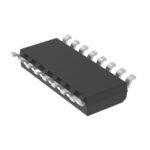 MC74HC174ADR2

The activity of extra discounts on wholesale prices is in full swing…
Please fill in your contact information and we will send you the latest wholesale price list.





