 ChipApex | Global Electronic Components Supplier

SEARCH
Search Product
Search Post
— IC芯片 | 连接器 | 传感器 | 被动器件 —
Search productSearch post
— IC芯片 | 连接器 | 传感器 | 被动器件 —
Consult the customer manager about the wholesale price.
consultation hotline:86-132-6715-2157
email:[email protected]
Contact the product manager for consultation. One-stop consultation is available.
Do you want a lower wholesale price? Please send us your inquiry and we will reply immediately.
The MC74HC4053ANG is a triple 2-to-1 analog multiplexer/demultiplexer manufactured by onsemi in the HC4053A series. It utilizes silicon-gate CMOS technology to provide fast switching speeds and low ON resistance. The device features three independent SPDT switches controlled by digital inputs A, B, and C, along with an active-high Enable pin that turns all switches off when HIGH. It operates with a single digital supply voltage (VCC) of 2.0 V to 6.0 V referenced to GND, while the analog signal range spans from VEE to VCC, allowing for dual supplies up to ±6.0 V or a total span of 12.0 V. The component is housed in a 16-pin PDIP package.
Verify the specific ordering suffix 'N' corresponds to the PDIP-16 package type as defined in the manufacturer's documentation. Confirm RoHS compliance status through official material declarations, as the 'G' suffix typically denotes lead-free packaging while other suffixes may vary. Ensure the procurement source provides valid traceability for this discontinued or legacy part number if applicable.
Select this component when a triple 2-to-1 analog switching solution is required within a 16-pin DIP footprint. Verify that the maximum analog voltage swing does not exceed the difference between VCC and VEE. Ensure the control logic voltage levels are compatible with the HC series thresholds or utilize appropriate level shifting for TTL interfaces.
This device belongs to the MC74HC405xA family, which includes the MC74HC4051A (8-channel) and MC74HC4052A (dual 4-channel). All members share identical pinouts and core CMOS architecture but differ in channel count and configuration. The HC4053A specifically provides three independent SPDT switches, offering a middle ground between the simpler HC4051A and the dual-pole HC4052A.
MC74HC4053ADWG
The Enable pin is active-high. When the Enable input is HIGH, all three analog switches are turned off, isolating the common outputs/inputs from the selected channels.
The analog signals can vary across the complete power supply range, from VEE to VCC. The total difference between VCC and VEE can be up to 12.0 V.
Yes, each of the three switches (X, Y, and Z) has its own dedicated channel-select inputs (A, B, and C respectively), allowing for independent control of each path.
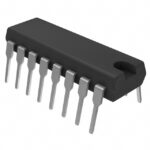 MC74HC4053ANG

The activity of extra discounts on wholesale prices is in full swing…
Please fill in your contact information and we will send you the latest wholesale price list.





