 ChipApex | Global Electronic Components Supplier

SEARCH
Search Product
Search Post
— IC芯片 | 连接器 | 传感器 | 被动器件 —
Search productSearch post
— IC芯片 | 连接器 | 传感器 | 被动器件 —
Consult the customer manager about the wholesale price.
consultation hotline:86-132-6715-2157
email:[email protected]
Contact the product manager for consultation. One-stop consultation is available.
Do you want a lower wholesale price? Please send us your inquiry and we will reply immediately.
The MC74HC4066AFELG is a quad bilateral analog switch manufactured by onsemi using silicon-gate CMOS technology. It operates within a supply voltage range of 2.0 V to 12.0 V and supports analog signals across the full power-supply range. The device features four independent single-pole single-throw (SPST) switches with low ON resistance, high OFF isolation, and low leakage current. It includes diode protection on all inputs and outputs for electrostatic discharge safety. The component is available in SOIC-14 and TSSOP-14 packages, ensuring compatibility with standard CMOS logic levels.
Verify the specific package suffix (D for SOIC-14 or DT for TSSOP-14) required for your PCB layout, as the base part number MC74HC4066A covers multiple physical form factors. Confirm that the 'G' suffix indicates a lead-free, halogen-free, and RoHS-compliant package. Ensure the ordering information matches the exact tape and reel specifications if bulk quantities are needed.
Select this component when a quad SPST analog switch is required with a wide supply voltage range up to 12 V. It is suitable for applications demanding low crosstalk and high off-channel isolation. Consider the HC4316A if voltage-level translation capabilities are necessary instead of direct switching. Verify that the operating temperature range of -55°C to +125°C meets the environmental requirements of the target system.
This device belongs to the 74HC4066A family of high-performance silicon-gate CMOS analog switches. It is functionally pin-compatible with older metal-gate CMOS devices like the MC14016 and MC14066 but offers superior linearity and speed. The 'AFELG' designation typically refers to a specific assembly lot and packaging configuration within the broader MC74HC4066A product line.
Direct functional substitutes include the SN74HC4066 from Texas Instruments and the TC74HC4066 from Toshiba. These components share identical pinouts and logical functions. Verify that the replacement's maximum ON resistance and propagation delay characteristics align with the original design constraints.
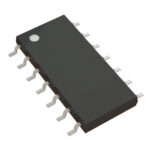 MC74HC4066AFELG

The activity of extra discounts on wholesale prices is in full swing…
Please fill in your contact information and we will send you the latest wholesale price list.





