 ChipApex | Global Electronic Components Supplier

SEARCH
Search Product
Search Post
— IC芯片 | 连接器 | 传感器 | 被动器件 —
Search productSearch post
— IC芯片 | 连接器 | 传感器 | 被动器件 —
Consult the customer manager about the wholesale price.
consultation hotline:86-132-6715-2157
email:[email protected]
Contact the product manager for consultation. One-stop consultation is available.
Do you want a lower wholesale price? Please send us your inquiry and we will reply immediately.
The MC74HC4066AN is a quad analog switch manufactured by onsemi, utilizing silicon-gate CMOS technology. It features four independent bilateral switches with SPST configuration in a 14-pin DIP package. The device operates on a single supply voltage ranging from 2.0 V to 12.0 V. Key electrical parameters include a maximum ON resistance of 70 Ω at 9.0 V and 12.0 V supplies, with a maximum propagation delay of 10 ns at these voltages. The OFF-channel leakage current is limited to 0.1 µA at 12.0 V. The component supports an operating temperature range from -55°C to +125°C and includes diode protection on all inputs and outputs.
Verify the specific suffix 'AN' corresponds to the 14-pin PDIP package when sourcing replacements. Confirm RoHS compliance status as older production runs may differ. Check for automotive qualified variants if the application requires AEC-Q100 certification. Ensure the supplier provides official datasheets matching the MC74HC4066A designation to guarantee parameter accuracy.
Select this component for applications requiring high-speed analog switching within a wide voltage range. The HC series offers faster propagation speeds than standard 4000B series devices. Consider the DIP package for prototyping or through-hole designs. Evaluate the ON resistance linearity requirements against the specific supply voltage conditions to ensure signal integrity.
This device belongs to the 74HC logic family, providing compatibility with standard CMOS outputs. It serves as a high-performance alternative to older metal-gate CMOS switches like the MC14016 and MC14066, offering improved linearity and speed. The pinout remains identical to these legacy components, facilitating direct upgrades in existing designs.
SN74HC4066N (Texas Instruments)
The maximum ON resistance decreases as the supply voltage increases. At 2.0 V, it is up to 120 Ω, while at 9.0 V and 12.0 V, it is limited to 70 Ω.
The analog input voltage can range from GND to VCC, allowing the switch to control signals across the full power-supply range.
Yes, with pull-up resistors, the ON/OFF control inputs are compatible with LSTTL outputs.
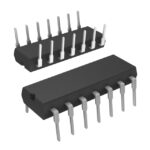 MC74HC4066AN

The activity of extra discounts on wholesale prices is in full swing…
Please fill in your contact information and we will send you the latest wholesale price list.





