 ChipApex | Global Electronic Components Supplier

SEARCH
Search Product
Search Post
— IC芯片 | 连接器 | 传感器 | 被动器件 —
Search productSearch post
— IC芯片 | 连接器 | 传感器 | 被动器件 —
Consult the customer manager about the wholesale price.
consultation hotline:86-132-6715-2157
email:[email protected]
Contact the product manager for consultation. One-stop consultation is available.
Do you want a lower wholesale price? Please send us your inquiry and we will reply immediately.
The MC74HC4066FL2 is a quad bilateral switch manufactured by onsemi, belonging to the 74HC logic family. It integrates four independent SPST analog switches within a single package, configured as a 4 x 1:1 multiplexer/demultiplexer array. The device operates on a single supply voltage ranging from 2 V to 12 V. Key electrical specifications include a maximum on-resistance of 70 Ohms and a bandwidth of 160 MHz. Propagation delay is specified at 40 ns, with turn-on and turn-off times reaching up to 80 ns. The component supports an operating temperature range from -55°C to +125°C and is housed in a TSSOP-14 surface-mount package.
Verify the specific ordering suffix against official manufacturer documentation to confirm package type and tape-and-reel specifications. Confirm RoHS compliance status through current datasheets or material declarations, as manufacturing processes may evolve. Ensure the selected variant matches the required thermal and electrical ratings for the target application environment before finalizing procurement.
Select this component when a quad SPST analog switch is required within the 74HC logic family constraints. Compare the 70 Ohm on-resistance and 160 MHz bandwidth against system requirements to ensure signal integrity. Consider the TSSOP-14 package dimensions for PCB layout compatibility. Evaluate the -55°C to +125°C operating range against environmental conditions to determine suitability for industrial or automotive applications.
This part belongs to the MC74HC4066 series of quad analog switches produced by onsemi. It is functionally equivalent to other industry-standard 74HC4066 devices but adheres to onsemi's specific manufacturing parameters. The series is designed for general-purpose analog switching tasks where low power consumption and high speed are prioritized over ultra-low on-resistance found in bipolar counterparts.
Direct functional substitutes include the MM74HC4066MTCX and SN74HC4066PWR. Verify pinout compatibility and electrical parameter tolerances, particularly on-resistance and propagation delay, before substituting. Ensure the replacement part meets the same package and thermal requirements.
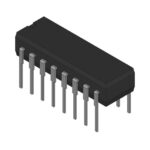 MC74HC4066FL2

The activity of extra discounts on wholesale prices is in full swing…
Please fill in your contact information and we will send you the latest wholesale price list.





