 ChipApex | Global Electronic Components Supplier

SEARCH
Search Product
Search Post
— IC芯片 | 连接器 | 传感器 | 被动器件 —
Search productSearch post
— IC芯片 | 连接器 | 传感器 | 被动器件 —
Consult the customer manager about the wholesale price.
consultation hotline:86-132-6715-2157
email:[email protected]
Contact the product manager for consultation. One-stop consultation is available.
Do you want a lower wholesale price? Please send us your inquiry and we will reply immediately.
The MC74HCT4066ADR2G is a quad analog switch manufactured by onsemi, utilizing silicon-gate CMOS technology. It features four independent bilateral switches designed to control analog and digital voltages across the full power-supply range (VCC to GND). The device operates within a recommended supply voltage of 4.5 V to 5.5 V and supports an analog input voltage range from GND to VCC. Key electrical specifications include a maximum ON resistance of 120 Ω at 25°C and 4.5 V, with a propagation delay of 10 ns. The component is housed in a SOIC-14 package and is rated for operation between -55°C and +125°C.
Verify the specific ordering suffix 'R2G' corresponds to the SOIC-14 tape and reel configuration containing 2500 units per reel. Confirm RoHS compliance status and Pb-Free designation as indicated by the 'G' suffix in the marking diagram. Ensure the source document matches the July 2026 Rev. 3 datasheet to validate current manufacturing status and pinout definitions.
Select this component when LSTTL-compatible control signals are required for analog switching applications. The device is suitable for designs needing a wide operating temperature range up to +125°C. Consider the SOIC-14 package dimensions and thermal dissipation characteristics if high power density is expected in the application environment.
This part belongs to the MC74HCT4066A series of quad analog switches. It shares pinout compatibility with the legacy metal-gate CMOS MC14016 and MC14066 devices. The 'ADR2G' suffix specifically denotes the SOIC-14 package variant supplied in tape and reel format for automated assembly processes.
MC74HC4066ADTR2G: HC series with wider voltage range but different input thresholds.
The maximum static or dynamic voltage across the switch (VIO) is limited to 1.2 V. Exceeding this limit while the switch is on may cause excessive VCC current draw.
At 4.5 V supply, the maximum ON resistance increases from 120 Ω at -55°C to 200 Ω at +125°C.
Unused analog pins may be left floating, but it is advisable to tie them to VCC or GND through a low-value resistor to minimize crosstalk and feedthrough noise.
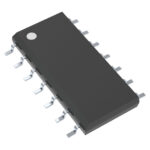 MC74HCT4066ADR2G

The activity of extra discounts on wholesale prices is in full swing…
Please fill in your contact information and we will send you the latest wholesale price list.





