 ChipApex | Global Electronic Components Supplier

SEARCH
Search Product
Search Post
— IC芯片 | 连接器 | 传感器 | 被动器件 —
Search productSearch post
— IC芯片 | 连接器 | 传感器 | 被动器件 —
Consult the customer manager about the wholesale price.
consultation hotline:86-132-6715-2157
email:[email protected]
Contact the product manager for consultation. One-stop consultation is available.
Do you want a lower wholesale price? Please send us your inquiry and we will reply immediately.
The MC74HCT4851ADR2G-Q is an automotive-grade analog multiplexer/demultiplexer manufactured by onsemi. It features injection current effect control, allowing disabled channel signals to exceed the supply voltage without affecting the enabled channel. The device operates within a power supply range of 4.5 V to 5.5 V and supports an operating temperature range from -55°C to +125°C. Key electrical parameters include a maximum propagation delay of 45 ns at 25°C and up to 50 ns at 125°C. The maximum 'ON' resistance is guaranteed at 650 Ω across the full temperature range. Input leakage current is limited to ±1.0 µA.
Verify that the ordering suffix matches the required package type and tape-and-reel specifications. Confirm that the NLV prefix or specific suffix indicates the necessary automotive quality level and unique site requirements. Ensure compliance with RoHS standards and lead-free packaging requirements as specified in the manufacturer's documentation.
Select this component when LSTTL input compatibility and injection current protection are required. Verify that the 4.5 V to 5.5 V supply voltage range aligns with the system design. Consider the SOIC-16 package dimensions if space constraints exist. Ensure the operating temperature range meets the environmental conditions of the application.
This part belongs to the MC74HCT4851A family of analog multiplexers. It is pin-compatible with standard HC405x and MC1405xB devices but offers enhanced injection current handling. The Q suffix typically denotes automotive-grade qualification, distinguishing it from commercial variants.
Direct replacements include MC74HCT4851ADTR2G (TSSOP-16) or MC74HCT4851ADR2G (SOIC-16). Verify that substitute parts meet the same AEC-Q100 and PPAP requirements if automotive qualification is mandatory.
The maximum shift is less than 1 mV/mA when the injected current is ≤ 1 mA and source resistance is ≤ 3.9 kΩ.
Yes, the Channel Select and Enable inputs are compatible with standard CMOS or LSTTL outputs.
The chip complexity is 154 FETs or 36 equivalent gates.
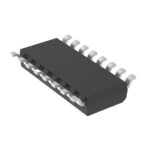 MC74HCT4851ADR2G-Q

The activity of extra discounts on wholesale prices is in full swing…
Please fill in your contact information and we will send you the latest wholesale price list.





