 ChipApex | Global Electronic Components Supplier

SEARCH
Search Product
Search Post
— IC芯片 | 连接器 | 传感器 | 被动器件 —
Search productSearch post
— IC芯片 | 连接器 | 传感器 | 被动器件 —
Consult the customer manager about the wholesale price.
consultation hotline:86-132-6715-2157
email:[email protected]
Contact the product manager for consultation. One-stop consultation is available.
Do you want a lower wholesale price? Please send us your inquiry and we will reply immediately.
The MC74LVX4053DR2 is a triple single-pole double-throw (SPDT) analog multiplexer/demultiplexer manufactured by onsemi. It utilizes high-performance silicon-gate CMOS technology to achieve fast propagation delays, low ON resistance, and low OFF leakage currents. The device supports an analog power supply range of -3.0 V to +3.0 V and a digital control supply range of 2.5 V to 6.0 V. It features three independent switches with channel-select inputs A, B, and C, and a common Enable pin. When the Enable input is HIGH, all analog switches are turned off. The package type is SOIC-16.
Verify the specific ordering suffix DR2 corresponds to the SOIC-16 tape and reel packaging configuration. Confirm RoHS compliance status as indicated by the manufacturer's current product specifications. Ensure the component matches the required lead-free package standards for your assembly process.
Select this component when low ON resistance and high bandwidth are required for analog signal paths. Verify that the digital control voltage levels are compatible with your system logic family. Consider the thermal dissipation capabilities of the SOIC-16 package if operating at elevated temperatures or high load currents.
This part belongs to the MC74LVX4053 series of analog multiplexers. It shares pinout compatibility with devices such as the LVX8053, HC4053A, and metal-gate MC14053B. The series is designed for applications requiring high-speed analog switching with low distortion and crosstalk characteristics.
Direct functional substitutes include the MC74LVX4053D (tube packaging) or MC74LVX4053DG (Pb-free tube). Cross-manufacturer equivalents like the SN74LV4053ATPWREP may be considered but require verification of electrical parameters and pinout compatibility.
The analog voltage can vary across the complete power supply range from VCC to VEE. For example, with VCC at +5V and VEE at GND, the signal can swing between these limits.
When the Enable pin is set to a HIGH logic level, all three analog switches within the device are turned off, isolating the common outputs/inputs from the selected channels.
Yes, with the addition of pullup resistors, the Channel-Select and Enable inputs are compatible with LSTTL output logic levels.
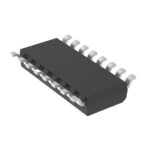 MC74LVX4053DR2

The activity of extra discounts on wholesale prices is in full swing…
Please fill in your contact information and we will send you the latest wholesale price list.





