 ChipApex | Global Electronic Components Supplier

SEARCH
Search Product
Search Post
— IC芯片 | 连接器 | 传感器 | 被动器件 —
Search productSearch post
— IC芯片 | 连接器 | 传感器 | 被动器件 —
Consult the customer manager about the wholesale price.
consultation hotline:86-132-6715-2157
email:[email protected]
Contact the product manager for consultation. One-stop consultation is available.
Do you want a lower wholesale price? Please send us your inquiry and we will reply immediately.
The MC74LVXT4052D is a high-performance silicon-gate CMOS analog multiplexer/demultiplexer manufactured by onsemi. It features double-pole, 4-position plus common-off configuration within a SOIC-16 package. The device operates with a digital power supply range of 2.5 V to 6.0 V and supports an analog power supply range from -3.0 V to +3.0 V relative to ground. Key electrical parameters include a maximum ON resistance of 86 Ohms at 3.0 V, propagation delays up to 40 ns, and a bandwidth of 80 MHz. It offers low OFF leakage currents, break-before-make circuitry, and TTL-compatible control inputs.
Verify the specific ordering suffix 'D' corresponds to the SOIC-16 package variant when sourcing components. Confirm RoHS compliance status if lead-free requirements are mandatory for the assembly process. Ensure that the procurement documentation matches the manufacturer's official part number MC74LVXT4052D to avoid substitution errors with similar logic families.
Select this component when designing circuits requiring dual 4-to-1 analog switching with independent control. It is suitable for applications demanding low crosstalk and high isolation. Consider the SOIC-16 package constraints regarding thermal dissipation and board space. Verify that the control voltage levels align with the TTL compatibility specifications of the system logic.
This device belongs to the LVXT series of analog switches, designed for low-voltage digital control of analog signals. It serves as a functional replacement for older HC4052A and metal-gate MC14052B devices while offering superior performance metrics. The LVXT family emphasizes linear ON resistance and low noise characteristics for precision analog applications.
MC74LVXT4052DG is the lead-free version of the same device in the SOIC-16 package. MC74LVXT4052DTG is the equivalent component housed in a TSSOP-16 package. These parts share identical electrical characteristics and pinouts, allowing for direct substitution based on packaging requirements.
Unused analog inputs/outputs may be left floating. However, tying them to VCC or GND through a low-value resistor helps minimize crosstalk and feedthrough noise picked up by the unused switch.
If voltage transients above VCC or below VEE are anticipated, external Germanium or Schottky diodes should be connected to the analog channels to absorb current surges during clipping.
Yes, the device is designed to operate using split supplies up to +/- 3.0 V, in addition to single-supply configurations where VEE is connected to GND.
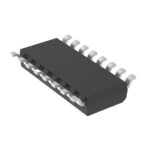 MC74LVXT4052D

The activity of extra discounts on wholesale prices is in full swing…
Please fill in your contact information and we will send you the latest wholesale price list.





