 ChipApex | Global Electronic Components Supplier

SEARCH
Search Product
Search Post
— IC芯片 | 连接器 | 传感器 | 被动器件 —
Search productSearch post
— IC芯片 | 连接器 | 传感器 | 被动器件 —
Consult the customer manager about the wholesale price.
consultation hotline:86-132-6715-2157
email:[email protected]
Contact the product manager for consultation. One-stop consultation is available.
Do you want a lower wholesale price? Please send us your inquiry and we will reply immediately.
The MC74VHC4053DR2 is a high-performance silicon-gate CMOS analog multiplexer/demultiplexer manufactured by onsemi. It integrates three independent single-pole double-throw (SPDT) switches within a 16-pin SOIC package. The device supports an analog power supply range of 2.0 V to 12.0 V and a digital control supply range of 2.0 V to 6.0 V. Key electrical characteristics include a maximum ON resistance of 100 Ω at 6.0 V, a maximum OFF leakage current of 1.0 μA, and a -3 dB bandwidth of 120 MHz. Propagation delays are specified at 45 ns for channel select-to-output transitions at 6.0 V.
Verify the specific ordering suffix DR2 corresponds to the SOIC-16 tape and reel configuration as defined in the manufacturer's documentation. Confirm that the component meets RoHS compliance standards required for the target assembly process. Ensure the supply voltage constraints are strictly observed during operation to prevent device damage.
Select this component when three independent SPDT analog switching functions are required in a compact surface-mount package. It is suitable for applications requiring bidirectional signal flow controlled by digital logic levels. Consider the 100 Ω ON resistance and 120 MHz bandwidth limits when designing for high-frequency or precision analog signal integrity.
This device belongs to the MC74VHC405x family of analog multiplexers, which also includes the 8-channel VHC4051 and the dual 4-channel VHC4052. These devices share identical pinouts with the legacy HC4051A/HC4052A/HC4053A series and the metal-gate MC14051B/MC14052B/MC14053B series, facilitating direct pin-compatible upgrades.
Public confirmed substitute part numbers include MC74VHC4053DTR2G.
Unused analog inputs or outputs may be left floating. However, tying them to VCC or GND through a low-value resistor is recommended to minimize crosstalk and feedthrough noise.
When the Enable pin is held HIGH, all internal analog switches are turned off, isolating the common output/input from the selected channels.
Yes, balanced supplies are not required. The constraints are that VCC-GND must be 2 to 6 volts, VEE-GND must be 0 to -6 volts, and VCC-VEE must be 2 to 12 volts.
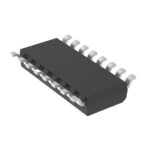 MC74VHC4053DR2

The activity of extra discounts on wholesale prices is in full swing…
Please fill in your contact information and we will send you the latest wholesale price list.





