 ChipApex | Global Electronic Components Supplier

SEARCH
Search Product
Search Post
Search productSearch post
Consult the customer manager about the wholesale price.
consultation hotline:86-132-6715-2157
email:[email protected]
Contact the product manager for consultation. One-stop consultation is available.
Do you want a lower wholesale price? Please send us your inquiry and we will reply immediately.
MCP33131-10-E/MS is listed in the Analog To Digital Converters (ADC) range at ChipApex. The manufacturer field lists Microchip Technology. Its product description is IC ADC 16BIT SAR 10MSOP. Review the specifications below when checking this part for your BOM.
The MCP33131-10-E/MS is a 16-bit, single-channel Successive Approximation Register (SAR) Analog-to-Digital Converter (ADC) from Microchip Technology. It operates at a throughput rate of 1 Msps with no missing codes and zero output latency. The device utilizes a pseudo-differential input architecture supporting a single-ended full-scale range from 0V to +VREF. Key electrical parameters include an analog supply voltage (AVDD) of 1.8V, a digital I/O interface voltage (DVIO) ranging from 1.7V to 5.5V, and an external reference voltage (VREF) between 2.5V and 5.1V. Typical performance metrics at VREF = 5V and fIN = 10 kHz include a Signal-to-Noise Ratio (SNR) of 86.7 dBFS, Spurious-Free Dynamic Range (SFDR) of 98.9 dB, and Total Harmonic Distortion (THD) of -97.4 dB.
Verify the specific ordering suffix '-E/MS' corresponds to the MSOP-10 package and extended temperature grade (-40°C to +125°C). Confirm AEC-Q100 qualification status if automotive compliance is required. Check RoHS and REACH compliance documentation for environmental regulations. Ensure the host system supports the required SPI timing constraints for 1 Msps operation.
Select this component when 16-bit accuracy and 1 Msps speed are required for single-ended inputs. The wide DVIO range (1.7V–5.5V) allows direct interfacing with various microcontrollers without level shifters. Consider the MCP33121 or MCP33111 variants if lower resolution or cost is preferred. Ensure the application can provide a stable external VREF between 2.5V and 5.1V.
This part belongs to the MCP331x1-XX family of SAR ADCs, which also includes 14-bit (MCP33121) and 12-bit (MCP33111) variants. The '10' suffix indicates a 1 Msps sample rate, while '05' would indicate 500 kSPS. The family shares similar pinouts and features but differs in resolution and dynamic performance specifications.
Publicly confirmed substitute part numbers are not available in the provided source material. Designers should verify pin compatibility and electrical parameter overlaps with other 16-bit SAR ADCs if cross-referencing is necessary.
The device features a pseudo-differential input operation that supports a single-ended configuration with an input full-scale range of 0V to +VREF.
The ADC performs automatic self-calibration for offset, gain, and linearity errors during power-up. Users can also initiate recalibration on-demand via a command during normal operation.
The serial clock (SCLK) rate can go up to 100 MHz, allowing for fast data readout compatible with high-speed host processors.
Explore related parts through Data Acquisition, Integrated Circuits (ICs), all product categories, ChipApex homepage.
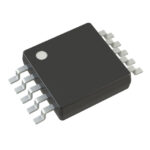 MCP33131-10-E/MS

The activity of extra discounts on wholesale prices is in full swing…
Please fill in your contact information and we will send you the latest wholesale price list.




