 ChipApex | Global Electronic Components Supplier

SEARCH
Search Product
Search Post
Search productSearch post
Consult the customer manager about the wholesale price.
consultation hotline:86-132-6715-2157
email:[email protected]
Contact the product manager for consultation. One-stop consultation is available.
Do you want a lower wholesale price? Please send us your inquiry and we will reply immediately.
MCP3426A0-E/MS is listed in the Analog To Digital Converters (ADC) range at ChipApex. The manufacturer field lists Microchip Technology. Its product description is IC ADC 16BIT SIGMA-DELTA 8MSOP. Review the specifications below when checking this part for your BOM.
The MCP3426A0-E/MS is a 16-bit, dual-channel Delta-Sigma Analog-to-Digital Converter (ADC) manufactured by Microchip Technology. It features an integrated I²C interface and an on-board 2.048V voltage reference with ±0.05% accuracy. The device supports differential inputs and includes a programmable gain amplifier (PGA) with gains of 1, 2, 4, or 8. It operates on a single supply voltage ranging from 2.7V to 5.5V and offers programmable data rates of 15 SPS (16-bit), 60 SPS (14-bit), and 240 SPS (12-bit). The component is housed in an 8-pin MSOP package and is qualified for automotive applications under the AEC-Q100 standard.
Verify the factory-programmed I²C address for the MCP3426 variant, as it differs from the user-configurable addresses of the MCP3427 and MCP3428 models. Confirm that the MSOP-8 package thermal characteristics meet the application's heat dissipation requirements. Ensure the system design accounts for the specific pull-up resistor values required for the selected I²C clock speed mode.
Select this component when a dual-channel ADC with high accuracy and low noise is required. The fixed factory address simplifies board layout compared to variants with external address pins. Consider the trade-off between data rate and current consumption; lower sampling rates significantly reduce power usage in one-shot mode. Verify that the input signal range fits within the ±2.048V/PGA full-scale range to avoid saturation.
This part belongs to the MCP342X series, which also includes the MCP3427 (dual channel, configurable address) and MCP3428 (quad channel). The primary distinction of the MCP3426 is its fixed I²C address programmed during manufacturing, eliminating the need for external address selection pins found on other family members.
MCP3426A0-E/SN: Same electrical specifications but packaged in an 8-pin SOIC instead of MSOP.
If the input voltage exceeds the maximum range defined by VREF/PGA, the output code will saturate and lock at all 1s (positive full scale) or all 0s except the sign bit (negative full scale).
The device performs automatic offset and gain calibration for each conversion, ensuring accurate results despite variations in temperature and power supply fluctuations.
Yes, although designed for differential inputs, the CHn- pin can be connected to VSS to allow for single-ended operation.
Explore related parts through Data Acquisition, Integrated Circuits (ICs), all product categories, ChipApex homepage.
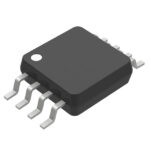 MCP3426A0-E/MS

The activity of extra discounts on wholesale prices is in full swing…
Please fill in your contact information and we will send you the latest wholesale price list.




