 ChipApex | Global Electronic Components Supplier
SEARCH
Search Product
Search Post
— IC芯片 | 连接器 | 传感器 | 被动器件 —
Search productSearch post
— IC芯片 | 连接器 | 传感器 | 被动器件 —
Consult the customer manager about the wholesale price.
consultation hotline:86-132-6715-2157
email:[email protected]
Contact the product manager for consultation. One-stop consultation is available.
Do you want a lower wholesale price? Please send us your inquiry and we will reply immediately.
The MCP3909-I/SS is an energy measurement integrated circuit designed for single-phase residential metering applications, supporting IEC 62053 specifications. It incorporates two 16-bit delta-sigma analog-to-digital converters with programmable gain up to 16 and a 20-bit multiplier output. The device provides active power pulse output proportional to average real power and an SPI interface for raw data access. Key electrical parameters include a supply voltage range of 4.5 V to 5.5 V, typical current consumption of 4 mA, and an on-chip voltage reference with 15 ppm/°C drift. Operating temperature ranges from -40°C to +85°C.
Verify the specific suffix (e.g., -I/SS) against official Microchip documentation to confirm operating temperature range and package type. Ensure compatibility with system voltage requirements (4.5 V to 5.5 V). Confirm AEC-Q100 Grade 1 qualification if automotive reliability is required. Cross-reference part numbers with authorized distributors to avoid counterfeit components.
Select this component for applications requiring high dynamic range measurement exceeding standard IEC requirements. The integrated PGA allows flexibility in signal conditioning for various input levels. Consider the SPI interface for digital processing integration. Evaluate thermal performance within the specified operating temperature range. Verify that the 4 mA typical current consumption aligns with system power budget constraints.
The MCP3909 belongs to Microchip's family of energy measurement ICs tailored for smart metering. It serves as an analog front-end solution combining precision ADCs with digital multipliers. The device simplifies design by integrating necessary functions for accurate active power calculation. It is commonly paired with microcontrollers like the PIC18F85J90 in reference designs for complete metering solutions.
Consult official Microchip documentation for verified substitute part numbers. Ensure any replacement maintains IEC 62053 compliance and compatible pinout. Verify equivalent ADC resolution and gain capabilities. Check for differences in operating temperature ranges and supply voltage specifications before implementation.
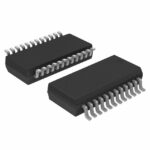 MCP3909-I/SS
The activity of extra discounts on wholesale prices is in full swing…
Please fill in your contact information and we will send you the latest wholesale price list.





