 ChipApex | Global Electronic Components Supplier

SEARCH
Search Product
Search Post
— IC芯片 | 连接器 | 传感器 | 被动器件 —
Search productSearch post
— IC芯片 | 连接器 | 传感器 | 被动器件 —
Consult the customer manager about the wholesale price.
consultation hotline:86-132-6715-2157
email:[email protected]
Contact the product manager for consultation. One-stop consultation is available.
Do you want a lower wholesale price? Please send us your inquiry and we will reply immediately.
The MCP4011T-502E/MC is a volatile, single-channel digital potentiometer manufactured by Microchip Technology. It features a nominal resistance of 5 kΩ with 64 taps (63 resistors) and a linear taper. The device operates on a supply voltage range of 1.8V to 5.5V for logic operation and 2.7V to 5.5V for specified resistor characteristics. Control is managed via a simple Up/Down serial interface. Key electrical parameters include a typical wiper resistance of 75 Ω, a maximum static current of 1 µA, and high-voltage tolerant inputs up to 12.5V. It supports an operating temperature range from -40°C to +125°C.
Verify the specific suffix 'MC' corresponds to the DFN-8 EP package configuration required for the design. Confirm that the volatile memory type aligns with system requirements, as the wiper setting resets to mid-scale upon power loss unless custom power-on settings are arranged directly with the manufacturer.
Select this component when a low-cost, single-channel digital potentiometer with high-voltage tolerant control lines is needed. Ensure the 5 kΩ resistance value fits the circuit's impedance constraints. Note that the bandwidth decreases with higher resistance values; the 5 kΩ variant typically offers approximately 2 MHz bandwidth at -3 dB.
This part belongs to the MCP4011/2/3/4 family of low-cost, 6-bit volatile digital potentiometers. While the MCP4011 is configured as a potentiometer, the family also includes rheostat variants (MCP4012/4) and different package options such as SOT-23, SOIC, and MSOP. The 'T' indicates tape and reel packaging, while '502' denotes the 5 kΩ resistance value.
Direct pin-compatible replacements within the same family include other resistance variants like MCP4011T-103E/MC (10 kΩ) or MCP4011T-503E/MC (50 kΩ). For non-volatile memory requirements, consider the MCP402x series, though interface and pinout differences may necessitate schematic changes.
The default power-on recall (POR) setting is mid-scale (code 1Fh hex).
Yes, floating either terminal A or terminal B allows the device to be configured and operated in rheostat mode.
The digital input pins (CS and U/D) are high-voltage tolerant and can withstand up to 12.5V with respect to VSS.
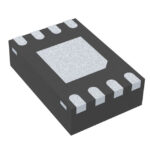 MCP4011T-502E/MC

The activity of extra discounts on wholesale prices is in full swing…
Please fill in your contact information and we will send you the latest wholesale price list.





