 ChipApex | Global Electronic Components Supplier

SEARCH
Search Product
Search Post
— IC芯片 | 连接器 | 传感器 | 被动器件 —
Search productSearch post
— IC芯片 | 连接器 | 传感器 | 被动器件 —
Consult the customer manager about the wholesale price.
consultation hotline:86-132-6715-2157
email:[email protected]
Contact the product manager for consultation. One-stop consultation is available.
Do you want a lower wholesale price? Please send us your inquiry and we will reply immediately.
The MCP4017T-503E/LT is a single-channel digital potentiometer manufactured by Microchip Technology. It features a 50 kΩ total resistance (R_AB) with 7-bit resolution, providing 128 discrete wiper steps. The device operates on a supply voltage range of 1.8V to 5.5V and utilizes an I²C serial interface for control. It employs volatile RAM memory, resetting the wiper to mid-scale upon power-up. Key electrical characteristics include a typical wiper resistance of 100 Ω, a bandwidth of 260 kHz at 50 kΩ, and low static current consumption of 2.5 µA. The component is housed in a compact SC70-6 package and supports operation across an extended temperature range from -40°C to +125°C.
Verify the specific suffix 'LT' corresponds to the tape-and-reel packaging format when sourcing components. Confirm that the application design accommodates volatile memory behavior, as wiper settings are lost during power cycles. Ensure the I²C bus pull-up resistors are selected appropriately for the operating voltage range of 1.8V to 5.5V to maintain signal integrity.
Select this model for applications requiring a single-channel variable resistance controlled via I²C. The 50 kΩ value suits moderate impedance networks; lower values like 5 kΩ offer higher bandwidth, while 100 kΩ provides higher impedance. Consider the SC70-6 package size constraints and verify that the 100 Ω typical wiper resistance meets the load requirements of the target circuit.
This component belongs to the MCP4017/18/19 family of 7-bit digital potentiometers. The MCP4017 variant specifically supports rheostat configuration, whereas the MCP4018 supports potentiometer configuration, both sharing the same SC70-6 footprint and electrical specifications. The 'T' designation indicates reel packaging, distinguishing it from cut-tape variants.
The MCP4018T-503E/LT offers identical electrical performance but is configured for potentiometer use rather than rheostat. For non-volatile memory retention, consider the MCP4022 series which utilizes EEPROM instead of RAM. SPI-based alternatives such as the MCP4132 provide similar resolution but require a different interface protocol.
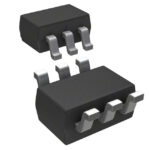 MCP4017T-503E/LT

The activity of extra discounts on wholesale prices is in full swing…
Please fill in your contact information and we will send you the latest wholesale price list.





