 ChipApex | Global Electronic Components Supplier

SEARCH
Search Product
Search Post
— IC芯片 | 连接器 | 传感器 | 被动器件 —
Search productSearch post
— IC芯片 | 连接器 | 传感器 | 被动器件 —
Consult the customer manager about the wholesale price.
consultation hotline:86-132-6715-2157
email:[email protected]
Contact the product manager for consultation. One-stop consultation is available.
Do you want a lower wholesale price? Please send us your inquiry and we will reply immediately.
The MCP4018T-502E/LT is a single-channel digital potentiometer IC manufactured by Microchip Technology. It features a 7-bit resolution providing 128 discrete wiper steps and utilizes volatile RAM for memory storage. The device operates within a supply voltage range of 1.8V to 5.5V, with analog characteristics specified from 2.7V to 5.5V. It employs an I²C serial interface for control and offers a typical low-power static current consumption of 2.5 µA. The component is housed in a compact SC-70-6 surface-mount package and supports operation across an extended temperature range of -40°C to +125°C.
Verify the specific resistance value suffix '502' corresponds to the required 5 kΩ nominal resistance for the design. Confirm that the volatile memory type meets system requirements, as settings are lost upon power loss. Ensure the SC-70-6 package dimensions fit the PCB footprint constraints. Check for RoHS compliance status if environmental regulations apply to the final assembly.
Select this model over rheostat variants like the MCP4017 when a three-terminal potentiometer configuration is necessary. The 5 kΩ resistance value is suitable for moderate current applications; higher resistance values may be needed for lower power dissipation. Verify that the host controller supports the I²C protocol and can handle the required bus speeds. Consider the 1.8V minimum operating voltage if interfacing with low-voltage logic systems.
This component belongs to the MCP4017/18/19 family of 7-bit digital potentiometers. The MCP4018 variant specifically provides a potentiometer configuration, distinguishing it from the rheostat-only MCP4017 and MCP4019 models. All devices in this series share similar electrical characteristics and pinouts, differing primarily in terminal connectivity and package options.
Direct functional replacements within the same family include the MCP4017T-502E/LT (rheostat configuration) and MCP4019T-502E/LT (rheostat configuration). Other Microchip digital potentiometers with I²C interfaces may serve as alternatives if pin compatibility or memory retention requirements differ.
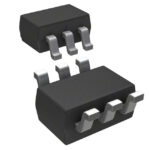 MCP4018T-502E/LT

The activity of extra discounts on wholesale prices is in full swing…
Please fill in your contact information and we will send you the latest wholesale price list.





