 ChipApex | Global Electronic Components Supplier

SEARCH
Search Product
Search Post
— IC芯片 | 连接器 | 传感器 | 被动器件 —
Search productSearch post
— IC芯片 | 连接器 | 传感器 | 被动器件 —
Consult the customer manager about the wholesale price.
consultation hotline:86-132-6715-2157
email:[email protected]
Contact the product manager for consultation. One-stop consultation is available.
Do you want a lower wholesale price? Please send us your inquiry and we will reply immediately.
The MCP4021T-202E/MC is a nonvolatile digital potentiometer manufactured by Microchip Technology, housed in an 8-lead DFN (2x3 mm) package. It features a nominal resistance of 2.1 kΩ with a tolerance of ±20% and offers 64 discrete taps for precise adjustment. The device operates on a supply voltage range of 2.7V to 5.5V and supports an extended industrial temperature range from -40°C to +125°C. Control is managed via a simple Up/Down serial interface, utilizing WiperLock technology to store the wiper setting in EEPROM for power-on recall.
Verify the specific suffix 'MC' corresponds to the 8-DFN (2x3 mm) package with an exposed thermal pad. Confirm that the 'T' indicates tape and reel packaging if automated placement is required. Ensure the 'E' suffix denotes the extended temperature grade (-40°C to +125°C). Cross-reference the datasheet DS20001945F for pinout compatibility with existing PCB footprints.
Select this component when a single-channel digital potentiometer with nonvolatile memory is required in a compact surface-mount footprint. The 2.1 kΩ value suits low-power signal conditioning or audio paths where moderate impedance is acceptable. Consider the 70 Ω typical wiper resistance for voltage drop calculations. For rheostat configurations, ensure terminal A or B is left floating as per datasheet guidelines.
This part belongs to the MCP4021/2/3/4 family of low-cost nonvolatile digital potentiometers. While the MCP4021 is configured as a potentiometer, the family includes rheostat variants (MCP4022/24) and different package options like SOT-23 and SOIC. The 'T-202E/MC' designation specifically identifies the 2.1 kΩ variant in the DFN package within the WiperLock-enabled series.
Direct pin-compatible replacements within the same package include other resistance values in the MCP4021 series (e.g., MCP4021T-502E/MC for 5 kΩ). For different packages, the MCP4021T-202E/SN (SOIC-8) offers electrical equivalence but requires a larger footprint. Verify interface compatibility as some legacy digital pots may use SPI rather than the Up/Down protocol.
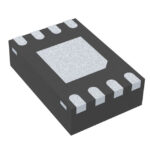 MCP4021T-202E/MC

The activity of extra discounts on wholesale prices is in full swing…
Please fill in your contact information and we will send you the latest wholesale price list.





