 ChipApex | Global Electronic Components Supplier
SEARCH
Search Product
Search Post
— IC芯片 | 连接器 | 传感器 | 被动器件 —
Search productSearch post
— IC芯片 | 连接器 | 传感器 | 被动器件 —
Consult the customer manager about the wholesale price.
consultation hotline:86-132-6715-2157
email:[email protected]
Contact the product manager for consultation. One-stop consultation is available.
Do you want a lower wholesale price? Please send us your inquiry and we will reply immediately.
The MCP4812-E/P is a dual-channel, 10-bit voltage output Digital-to-Analog Converter (DAC) manufactured by Microchip Technology. It operates on a single supply voltage ranging from 2.7V to 5.5V and features an internal 2.048V reference voltage. The device utilizes a resistive string architecture with rail-to-rail buffered outputs and supports SPI communication at clock frequencies up to 20 MHz. Key electrical specifications include a typical settling time of 4.5 µs, INL error of ±1 LSB at extended temperatures, and DNL error of ±0.2 LSB. It is housed in an 8-pin PDIP package and functions within an operating temperature range of -40°C to +125°C.
Verify the specific suffix 'E/P' corresponds to the PDIP-8 package variant when sourcing components. Confirm that the ordering code matches the required temperature grade and packaging format. Cross-reference the manufacturer's latest datasheet revision to ensure compatibility with current design specifications and environmental compliance standards.
Select this component for applications requiring dual-channel analog output with moderate precision and fast settling times. Ensure the system logic levels are compatible with the SPI interface requirements. Verify that the load capacitance connected to VOUTA and VOUTB remains within the specified limits to maintain stability and prevent oscillation during operation.
This part belongs to the MCP48xx family of dual-channel DACs, which also includes the 8-bit MCP4802 and 12-bit MCP4822 variants. All members share identical pinouts, interfaces, and core architectures, differing primarily in resolution and associated linearity specifications. The PDIP-8 package provides through-hole mounting options suitable for prototyping and general-purpose circuit boards.
Direct functional substitutes within the same package and specification profile include the MCP4802-E/P and MCP4822-E/P. These parts share identical pin configurations and software compatibility but offer different resolutions. Verify that the specific linearity and accuracy requirements of the application align with the target replacement's datasheet parameters.
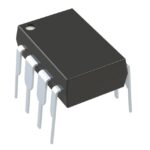 MCP4812-E/P
The activity of extra discounts on wholesale prices is in full swing…
Please fill in your contact information and we will send you the latest wholesale price list.






