 ChipApex | Global Electronic Components Supplier
SEARCH
Search Product
Search Post
— IC芯片 | 连接器 | 传感器 | 被动器件 —
Search productSearch post
— IC芯片 | 连接器 | 传感器 | 被动器件 —
Consult the customer manager about the wholesale price.
consultation hotline:86-132-6715-2157
email:[email protected]
Contact the product manager for consultation. One-stop consultation is available.
Do you want a lower wholesale price? Please send us your inquiry and we will reply immediately.
The MIC2810-4GSYML is a triple-output power management IC manufactured by Microchip Technology, formerly Micrel. It integrates one buck converter and two low-dropout (LDO) regulators within a single package. The switching regulator operates at a fixed frequency of 2MHz. Output 1 provides 1.2V at up to 600mA. Outputs 2 and 3 provide 1.8V and 3.3V respectively, each supporting up to 300mA. The device functions with an input voltage range of 1.65V to 5.5V and is rated for operation between -40°C and +85°C. It utilizes a 16-pin MLF® (4x4mm) surface-mount package.
Verify the manufacturer designation carefully, as the component was originally produced by Micrel Inc. before being acquired by Microchip Technology. Ensure the ordering suffix matches the required tape-and-reel configuration. Confirm that the specific output voltages and current ratings align with your design requirements, as variations exist within the MIC2810 family.
Select this component when space constraints necessitate integrating both switching and linear regulation into a single footprint. The 2MHz frequency is suitable for designs prioritizing small passive component size over maximum efficiency at very light loads. Verify that the thermal performance of the 16-MLF package meets the thermal dissipation requirements for the expected load currents and ambient temperatures.
This part belongs to the MIC2810 series of triple-output PMICs. It combines the efficiency of a DC-DC converter with the low noise of LDOs. The '4G' suffix typically denotes specific output configurations and packaging options within the Microchip portfolio. The device replaces older discrete solutions, reducing board area and assembly complexity for multi-rail power architectures.
Direct substitutes include other MIC2810 variants with compatible pinouts and electrical characteristics. Verify that any replacement maintains the same output voltage levels and current capacities. Cross-reference the package dimensions and thermal pad specifications to ensure mechanical compatibility with existing PCB footprints.
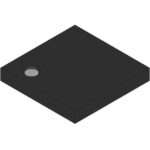 MIC2810-4GSYML
The activity of extra discounts on wholesale prices is in full swing…
Please fill in your contact information and we will send you the latest wholesale price list.





