 ChipApex | Global Electronic Components Supplier

SEARCH
Search Product
Search Post
— IC芯片 | 连接器 | 传感器 | 被动器件 —
Search productSearch post
— IC芯片 | 连接器 | 传感器 | 被动器件 —
Consult the customer manager about the wholesale price.
consultation hotline:86-132-6715-2157
email:[email protected]
Contact the product manager for consultation. One-stop consultation is available.
Do you want a lower wholesale price? Please send us your inquiry and we will reply immediately.
The MK2761AS is a clock synthesizer IC designed for set-top box applications. It accepts a 27 MHz crystal or clock input and generates multiple output clocks, including a 16.67 MHz processor clock, a fixed 3.6864 MHz clock, and four buffered 27 MHz reference clocks. The device features selectable audio sampling frequencies (32, 44.1, or 48 kHz) via ACS0/ACS1 pins, utilizing patented zero ppm error techniques to ensure exact tracking with video frequencies. Operating at 5.0 V ±10%, it provides 25 mA TTL drive capability in a 16-pin SOIC package.
Verify the specific suffix of the part number, as 'LF' indicates lead-free packaging which is RoHS compliant. Note that non-green parts have an End-of-Life date of May 13, 2010. Confirm availability status as the component may be discontinued or subject to limited supply.
Select the MK2761AS when a low-jitter clock source is required for set-top boxes. Ensure the design utilizes a fundamental mode parallel resonant crystal with 50 ppm or better stability connected to X1/X2 pins. Verify that the 5V supply requirement and 16-pin SOIC package fit the system constraints.
The MK2761AS is manufactured by Integrated Device Technology (IDT), which was later acquired by Renesas Electronics Corporation. It belongs to the IDT Set-Top Clock Source family, designed to replace discrete oscillators and PLL circuits in multimedia boards.
The MK2761ASTR is the tape and reel version of this component. The MK2761ASLF is the lead-free variant. No other direct functional substitutes are documented in the provided datasheet.
The audio clock frequency is determined by the logic states of the ACS1 and ACS0 input pins. Setting them to 0,0 selects 8.192 kHz; 0,1 selects 11.2896 kHz; 1,0 selects 12.288 kHz; and 1,1 selects 5.6448 kHz.
A fundamental mode, parallel resonant crystal with 50 ppm or better stability is required. Third overtone crystals should not be used.
Yes, the device's zero ppm error technique allows audio and video to track exactly, eliminating the need for large buffer memory in set-top box applications.
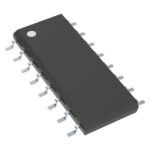 MK2761AS

The activity of extra discounts on wholesale prices is in full swing…
Please fill in your contact information and we will send you the latest wholesale price list.






