 ChipApex | Global Electronic Components Supplier
SEARCH
Search Product
Search Post
— IC芯片 | 连接器 | 传感器 | 被动器件 —
Search productSearch post
— IC芯片 | 连接器 | 传感器 | 被动器件 —
Consult the customer manager about the wholesale price.
consultation hotline:86-132-6715-2157
email:[email protected]
Contact the product manager for consultation. One-stop consultation is available.
Do you want a lower wholesale price? Please send us your inquiry and we will reply immediately.
The MMBZ16VTALT1G is a dual monolithic silicon Zener transient voltage suppressor from onsemi, housed in an SOT-23 package. It features a common anode configuration with two cathodes for protecting separate lines. The device provides a nominal breakdown voltage of 16 V with a tight 2% tolerance range (15.68 V to 16.32 V). It handles a peak pulse power of 40 W at 1.0 ms and operates within a junction temperature range of -55 °C to +150 °C.
Verify the specific ordering suffix when sourcing components. The 'T1' suffix indicates a standard 7-inch tape and reel containing 3,000 units. Confirm that the required automotive qualification and PPAP documentation are available if the application demands strict supply chain controls.
Select this component when a bidirectional or dual unidirectional TVS solution is needed for low-voltage lines requiring tight voltage accuracy. The 2% tolerance distinguishes it from standard 5% devices. Ensure the operating voltage does not exceed the 13 V working peak reverse voltage rating.
This part belongs to the MMBZxxxALT1G series of dual Zener diodes. While many series members offer 5% tolerance, the 'VT' designation specifically denotes the tighter 2% tolerance variant. It shares the same physical footprint and pinout as other members in the family but offers superior voltage consistency.
MMBZ16VALT1G serves as a direct functional substitute with identical electrical characteristics except for the looser 5% breakdown voltage tolerance. Both parts utilize the SOT-23 package and share the same pin configuration.
The primary difference is the breakdown voltage tolerance. The MMBZ16VTALT1G has a tight 2% tolerance, whereas the MMBZ16VALT1G has a standard 5% tolerance.
It consists of two Zener diodes connected in a common anode configuration, allowing Pin 3 to serve as the shared anode while Pins 1 and 2 act as independent cathodes.
Yes, the device is AEC-Q101 qualified and PPAP capable, making it suitable for automotive environments requiring unique site and control change requirements.
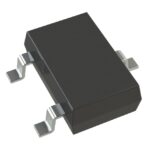 MMBZ16VTALT1G
The activity of extra discounts on wholesale prices is in full swing…
Please fill in your contact information and we will send you the latest wholesale price list.




