 ChipApex | Global Electronic Components Supplier
SEARCH
Search Product
Search Post
— IC芯片 | 连接器 | 传感器 | 被动器件 —
Search productSearch post
— IC芯片 | 连接器 | 传感器 | 被动器件 —
Consult the customer manager about the wholesale price.
consultation hotline:86-132-6715-2157
email:[email protected]
Contact the product manager for consultation. One-stop consultation is available.
Do you want a lower wholesale price? Please send us your inquiry and we will reply immediately.
The MMBZ47VTALT1G is a dual monolithic silicon Zener transient voltage suppressor in an SOT-23 package. It features a common anode configuration for protecting two separate lines. The device has a nominal breakdown voltage of 47 V with a tight 2% tolerance. It operates within a junction temperature range of -55°C to +150°C and dissipates 225 mW of steady-state power at 25°C. Peak pulse power handling is rated at 40 W for a 1.0 ms duration. Maximum reverse leakage current is specified at 50 nA, and the clamping voltage reaches 54 V at a peak pulse current of 43.1 A.
Verify the specific ordering suffix when sourcing components. The 'T1' suffix indicates a standard 3,000-unit tape and reel packaging format. Confirm that the required part includes the 'G' designation to ensure compliance with lead-free and RoHS manufacturing standards as defined by the manufacturer's current specifications.
Select this component for applications requiring dual-channel protection with strict voltage accuracy. The 2% tolerance variant is suitable where standard 5% devices may cause circuit malfunction. Ensure the operating environment supports the specified thermal derating curves for sustained power dissipation above 25°C ambient temperature.
This device belongs to the MMBZxxxALT1G series of dual Zener diodes manufactured by onsemi. The series utilizes a void-free transfer-molded thermosetting plastic case designed for automated board assembly. The product line offers various breakdown voltages ranging from 5.6 V to 47 V to accommodate different system requirements.
MMBZ47VALT1G serves as a direct functional substitute with identical pinout and package but features a wider 5% voltage tolerance instead of the 2% tolerance found in the VT variant.
The device is rated for a peak pulse power dissipation of 40 W measured at a pulse width of 1.0 ms.
The internal structure connects the anodes of two separate Zener diodes together, allowing Pin 3 to serve as a common ground reference while Pins 1 and 2 protect distinct signal lines.
Yes, the device meets AEC-Q101 qualification standards and is PPAP capable, making it suitable for automotive and other demanding applications.
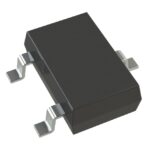 MMBZ47VTALT1G
The activity of extra discounts on wholesale prices is in full swing…
Please fill in your contact information and we will send you the latest wholesale price list.




