 ChipApex | Global Electronic Components Supplier
SEARCH
Search Product
Search Post
— IC芯片 | 连接器 | 传感器 | 被动器件 —
Search productSearch post
— IC芯片 | 连接器 | 传感器 | 被动器件 —
Consult the customer manager about the wholesale price.
consultation hotline:86-132-6715-2157
email:[email protected]
Contact the product manager for consultation. One-stop consultation is available.
Do you want a lower wholesale price? Please send us your inquiry and we will reply immediately.
The MMBZ5V6ALT1G is a dual monolithic silicon Zener transient voltage suppressor in an SOT-23 package. It features a common anode design to protect two separate lines. The device has a working peak reverse voltage of 3.0 V and a nominal breakdown voltage of 5.6 V. It handles a maximum reverse peak pulse current of 3.0 A with a clamping voltage of 8.0 V at that current. Peak power dissipation is 24 W for a 1.0 ms pulse. Maximum reverse leakage current is 5.0 µA at the working voltage. The component operates within a junction temperature range of -55 °C to +150 °C.
Verify the specific ordering suffix when sourcing components. The standard 'T1' suffix indicates a 7-inch tape and reel containing 3,000 units. The 'T3' suffix denotes a 13-inch tape and reel containing 10,000 units. Ensure the required packaging format matches the production line specifications before finalizing orders.
Select this component for applications requiring bidirectional or unidirectional ESD suppression on low-voltage data lines. The dual junction allows simultaneous protection of two circuits within limited board space. Verify that the 24 W peak power rating and 8.0 V clamping voltage are sufficient for the expected transient energy levels in the target system.
This part belongs to the MMBZxxxALT1G series of Zener Transient Voltage Suppressors manufactured by onsemi. The series utilizes a dual monolithic silicon structure housed in an SOT-23 case. It serves as a cost-effective solution for protecting sensitive electronics from electrostatic discharge and transient overvoltage events.
MMBZ5V6ALT3G: Identical electrical characteristics but supplied in a 10,000-unit 13-inch tape and reel instead of the 3,000-unit 7-inch reel.
The device contains two internal Zener diodes sharing a common anode terminal. This allows Pin 3 to serve as the ground reference while Pins 1 and 2 act as independent cathodes to clamp voltage spikes on two separate lines.
Using one junction creates a unidirectional protector for DC lines. Using both junctions back-to-back creates a bidirectional protector suitable for AC or differential signal lines.
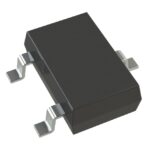 MMBZ5V6ALT1G
The activity of extra discounts on wholesale prices is in full swing…
Please fill in your contact information and we will send you the latest wholesale price list.




