ChipApex | Global Electronic Components Supplier
SEARCH
Search Product
Search Post
— IC芯片 | 连接器 | 传感器 | 被动器件 —
Search productSearch post
— IC芯片 | 连接器 | 传感器 | 被动器件 —
Consult the customer manager about the wholesale price.
consultation hotline:86-132-6715-2157
email:[email protected]
Contact the product manager for consultation. One-stop consultation is available.
Do you want a lower wholesale price? Please send us your inquiry and we will reply immediately.
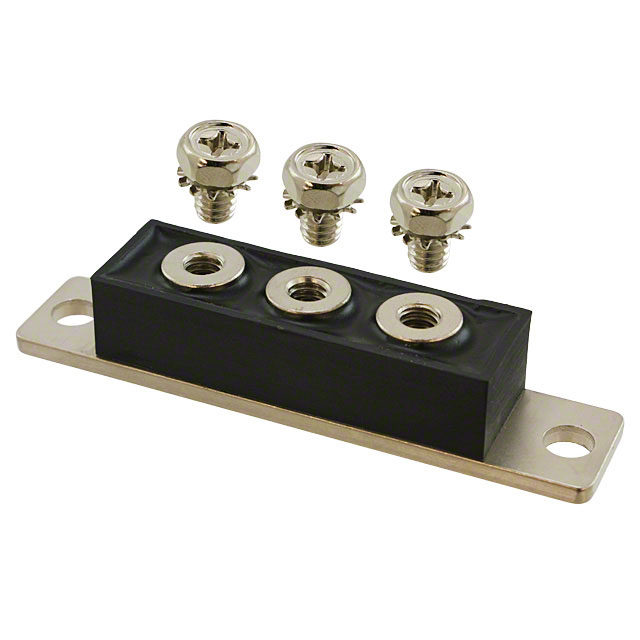
The MSRT100160AD is a silicon standard recovery diode module from the MSRT100120(A)D to MSRT100160(A)D series, manufactured by GeneSiC Semiconductor. It features a three-tower package with an electrically isolated base plate and operates within a junction temperature range of -55°C to 150°C. The device provides a repetitive peak reverse voltage (VRRM) of 1600 V and supports an average forward current of 100 A per leg. Key electrical characteristics include a maximum instantaneous forward voltage of 1.1 V at 100 A and 25°C, and a peak forward surge current capability of 2000 A.
Verify the specific suffix configuration against official GeneSiC documentation to ensure correct voltage rating and thermal specifications. Confirm that the ordered part matches the required VRRM and IF(AV) parameters for your circuit design. Check for any regional compliance certifications or packaging variations listed in the manufacturer's latest datasheet before finalizing procurement orders.
Select this component when a robust, isolated rectifier solution is needed for high-voltage applications up to 1600 V. Ensure the thermal management system can handle the specified junction-to-case thermal resistance. Compare the 100 A per leg rating against your load requirements and verify compatibility with the three-tower mounting style for your chassis design.
This module belongs to the MSRT100XXX series, which includes variants with different voltage ratings such as 1200 V and 1400 V. All models share the same physical footprint and electrical structure, differing primarily in their repetitive peak reverse voltage capabilities. This allows designers to standardize mechanical layouts while adjusting voltage ratings based on specific application needs.
Direct replacements must match the 1600 V VRRM, 100 A IF(AV), and three-tower isolated package dimensions. Verify that substitute components offer equivalent thermal resistance and surge current ratings to maintain system reliability without redesigning the cooling infrastructure.
The datasheet specifies the maximum thermal resistance from junction to case (Rθjc) but does not provide a numerical value in the provided text.
No, the device is explicitly documented as not being ESD sensitive.
The peak forward surge current (IFSM) is rated at 2000 A under half-sine wave conditions for 8.3 ms.
 MSRT100160AD
The activity of extra discounts on wholesale prices is in full swing…
Please fill in your contact information and we will send you the latest wholesale price list.