ChipApex | Global Electronic Components Supplier
SEARCH
Search Product
Search Post
— IC芯片 | 连接器 | 传感器 | 被动器件 —
Search productSearch post
— IC芯片 | 连接器 | 传感器 | 被动器件 —
Consult the customer manager about the wholesale price.
consultation hotline:86-132-6715-2157
email:[email protected]
Contact the product manager for consultation. One-stop consultation is available.
Do you want a lower wholesale price? Please send us your inquiry and we will reply immediately.
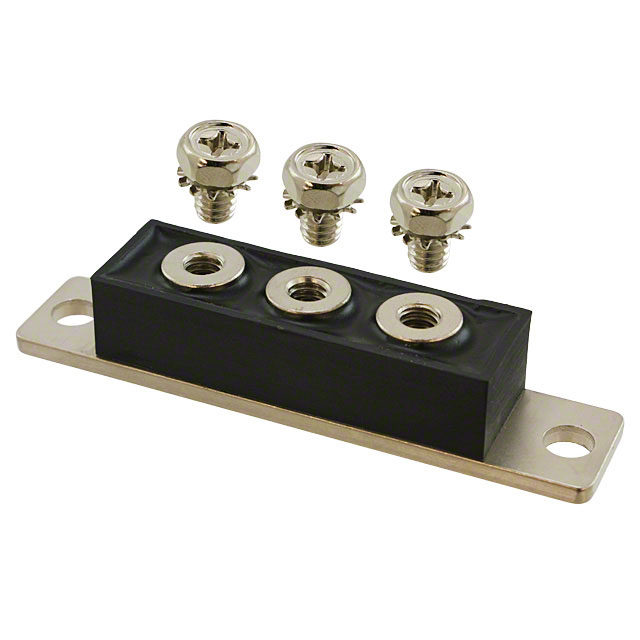
The MSRT10060D is a silicon standard recovery diode module from the MSRT100 series, manufactured by GeneSiC Semiconductor. It features a Three Tower Isolation Type package with an electrically isolated base plate. The device supports a repetitive peak reverse voltage (VRRM) of 600 V and an average forward current (IF(AV)) of 100 A per leg. Key electrical characteristics include a maximum instantaneous forward voltage of 566 mV at 100 A and 25 °C, and a peak forward surge current (IFSM) of 2000 A. The junction-to-case thermal resistance is 0.45 °C/W per leg. Operating temperature ranges from -55 °C to +150 °C.
Verify the specific suffix configuration against official documentation to ensure correct terminal arrangement and isolation specifications. Confirm that the 600 V rating aligns with system requirements. Check for RoHS compliance status in the latest datasheet revision. Ensure mounting hardware matches the Three Tower package dimensions. Validate thermal interface material compatibility for optimal heat dissipation.
Select this component for applications requiring high surge tolerance and galvanic isolation. The 100 A per leg rating suits moderate power levels. Consider the 0.45 °C/W thermal resistance for heatsink design. Compare with higher voltage variants if system transients exceed 600 V. Evaluate package size constraints against available board space.
This module belongs to the MSRT100 series, which includes variants ranging from 600 V to 1000 V reverse voltage. The series utilizes silicon standard recovery technology. Other models in the family include MSRT10080D and MSRT100100D. The Three Tower package design is consistent across the series, providing standardized mounting and thermal management solutions for industrial power electronics.
Direct substitutes within the same series include MSRT10080D and MSRT100100D, offering higher voltage ratings. Verify pinout compatibility before substitution. Cross-brand replacements require careful evaluation of thermal resistance and surge current capabilities.
 MSRT10060D
The activity of extra discounts on wholesale prices is in full swing…
Please fill in your contact information and we will send you the latest wholesale price list.