 ChipApex | Global Electronic Components Supplier
SEARCH
Search Product
Search Post
— IC芯片 | 连接器 | 传感器 | 被动器件 —
Search productSearch post
— IC芯片 | 连接器 | 传感器 | 被动器件 —
Consult the customer manager about the wholesale price.
consultation hotline:86-132-6715-2157
email:[email protected]
Contact the product manager for consultation. One-stop consultation is available.
Do you want a lower wholesale price? Please send us your inquiry and we will reply immediately.
The MUR1020CT is a dual ultrafast recovery rectifier from Vishay, utilizing FRED Pt technology. It features a common cathode configuration with two independent anodes in a TO-220AB package. The device supports a peak repetitive reverse voltage of 200 V and provides a total average rectified forward current of 10 A (5 A per leg). Key electrical specifications include a maximum reverse leakage current of 10 µA at rated voltage and 25 °C, and a typical reverse recovery time of 25 ns under specific test conditions. The component operates within a junction temperature range of -65 to 175 °C.
Verify the specific ordering suffix when sourcing. The 'PbF' designation indicates lead-free terminations compliant with RoHS directives, whereas standard production versions may contain lead. Confirm the package style matches the required mounting configuration, as the series is available in multiple form factors including TO-220AB, D-PAK, and TO-262. Ensure technical validation is performed for the specific application requirements.
Select this component for applications requiring high-frequency operation where minimizing switching losses is critical. The FRED Pt technology offers superior trade-offs between forward voltage and reverse recovery charge compared to standard ultrafast rectifiers. Consider the thermal resistance parameters and derating curves when designing heat sinking solutions for continuous high-current loads.
This device belongs to the MUR series of ultrafast plastic rectifiers manufactured by Vishay High Power Products. The series utilizes advanced FRED Pt (Fast Recovery Epitaxial Diode Platinum) technology to achieve high efficiency and ruggedness. The MUR1020CT specifically denotes a 10 A rating and 200 V voltage class within the dual common cathode configuration.
Cross-reference with other Vishay MUR series parts or equivalent ultrafast rectifiers from other manufacturers. Verify that substitute components match the 200 V reverse voltage, 10 A total current, and TO-220AB package dimensions. Ensure dynamic recovery characteristics are compatible with the target circuit's dIF/dt requirements.
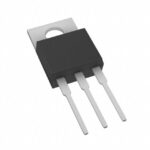 MUR1020CT
The activity of extra discounts on wholesale prices is in full swing…
Please fill in your contact information and we will send you the latest wholesale price list.




