 ChipApex | Global Electronic Components Supplier
SEARCH
Search Product
Search Post
— IC芯片 | 连接器 | 传感器 | 被动器件 —
Search productSearch post
— IC芯片 | 连接器 | 传感器 | 被动器件 —
Consult the customer manager about the wholesale price.
consultation hotline:86-132-6715-2157
email:[email protected]
Contact the product manager for consultation. One-stop consultation is available.
Do you want a lower wholesale price? Please send us your inquiry and we will reply immediately.
The MX604TN is a low-voltage, low-power CMOS V.23 compatible modem manufactured by CML Microcircuits in a 24-pin TSSOP package. It supports full-duplex operation with a 1200bps forward channel and an optional 75bps back channel. The device operates on a supply voltage of 3.0V to 5.5V, drawing a typical current of 1mA at 3.3V during active mode and 1µA in Zero-Power mode. It utilizes a standard 3.579545MHz crystal frequency for FSK modulation and demodulation.
Verify the specific suffix 'TN' corresponds to the 24-pin TSSOP package variant when sourcing components. Confirm that the application design accommodates the required 3.579545MHz clock source, as incorrect frequencies may cause device damage or undefined states. Ensure proper decoupling capacitors are placed near VDD and VBIAS pins to maintain signal integrity.
Select this component for designs requiring strict adherence to CCITT V.23 and ETSI specifications for asynchronous data transmission. Consider the integrated retiming feature if software overhead for UART handling must be minimized. Verify that the system power budget aligns with the 1µA Zero-Power mode requirement for standby applications.
The MX604TN belongs to the FX604/MX604 series of telecom interface ICs. It is functionally related to the MX604DW (SOIC) and MX604P (PDIP) variants, which share identical electrical characteristics but differ in physical packaging. This series is designed specifically for voiceband data communication over standard telephone lines.
MX604DW
Zero-Power mode is activated by setting both M0 and M1 input pins to a logic high level (VDD). In this state, power is removed from all internal circuitry, reducing current draw to approximately 1µA.
The RDY pin is an open-drain active-low output from the data retiming circuit. It indicates readiness for data transfer and can serve as an interrupt or wake-up signal to the associated microcontroller.
No, a 3.579545MHz clock is strictly required for correct FSK operation. This can be provided by an external oscillator connected to the XTAL/CLOCK pin, but the device cannot operate without a clock signal.
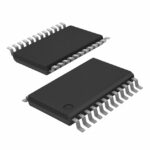 MX604TN
The activity of extra discounts on wholesale prices is in full swing…
Please fill in your contact information and we will send you the latest wholesale price list.





