 ChipApex | Global Electronic Components Supplier

SEARCH
Search Product
Search Post
— IC芯片 | 连接器 | 传感器 | 被动器件 —
Search productSearch post
— IC芯片 | 连接器 | 传感器 | 被动器件 —
Consult the customer manager about the wholesale price.
consultation hotline:86-132-6715-2157
email:[email protected]
Contact the product manager for consultation. One-stop consultation is available.
Do you want a lower wholesale price? Please send us your inquiry and we will reply immediately.
The NB2308AI5HDTR2G is a 3.3 V zero delay clock buffer manufactured by onsemi, designed for distributing high-speed clocks up to 133.3 MHz. It features an internal PLL that locks to the reference input on the REF pin, with feedback driven from one of the outputs to the FBK pin. The device provides eight buffered clock outputs organized into two banks of four (Bank A and Bank B). In this specific configuration, both output banks provide a divided-by-two frequency relative to the reference input. The part operates within a supply voltage range of 3.0 V to 3.6 V and supports an industrial temperature range of -40°C to +85°C.
Verify the component status as the NB2308A series may be subject to discontinuation notices. Confirm the package type matches the design requirements, as the 'DT' suffix denotes TSSOP-16 while 'D' denotes SOIC-16. Ensure the ordering suffix corresponds to the correct tape and reel quantity if bulk procurement is required. Check for RoHS compliance markings indicated by the 'G' suffix.
Select the NB2308AI5HDTR2G when a divide-by-two clock distribution is required for both output banks. The 'I' suffix specifies the industrial temperature range (-40°C to +85°C), suitable for harsher environments compared to commercial parts. The 'H' variant offers improved drive strength and switching speeds. Ensure the feedback path connects to an output capable of driving the necessary load capacitance (15 pF at frequencies above 100 MHz) to maintain zero delay characteristics.
This component belongs to the NB2308A family of 3.3 V zero delay buffers. Variants are distinguished by their frequency multiplication/division ratios (x1, x2, x3, x4, x5H) and drive strengths. The AI5H designation specifically identifies the industrial grade, high-drive version configured for REF/2 outputs on both banks. Other family members include NB2308AC1 through NB2308AC5H for commercial grades.
Publicly confirmed substitute part numbers for NB2308AI5HDTR2G were not found in the provided source material. Cross-referencing requires matching the 1:8 ratio, REF/2 configuration, and TSSOP-16 package constraints.
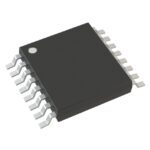 NB2308AI5HDTR2G

The activity of extra discounts on wholesale prices is in full swing…
Please fill in your contact information and we will send you the latest wholesale price list.






