 ChipApex | Global Electronic Components Supplier

SEARCH
Search Product
Search Post
— IC芯片 | 连接器 | 传感器 | 被动器件 —
Search productSearch post
— IC芯片 | 连接器 | 传感器 | 被动器件 —
Consult the customer manager about the wholesale price.
consultation hotline:86-132-6715-2157
email:[email protected]
Contact the product manager for consultation. One-stop consultation is available.
Do you want a lower wholesale price? Please send us your inquiry and we will reply immediately.
The NB2309AC1D is a 3.3 V zero delay clock buffer manufactured by onsemi, designed for high-speed clock distribution in PC, workstation, and datacom applications. It accepts one reference input and drives nine low-skew outputs grouped into two banks of four plus one feedback output. The device utilizes an on-chip PLL to lock to the input clock on the REF pin, achieving zero input-output propagation delay when outputs are uniformly loaded. Operating within a frequency range of 15 MHz to 133 MHz, it features less than 250 ps output-to-output skew and under 200 ps cycle-to-cycle jitter. The part is housed in a 16-pin SOIC package.
Verify the ordering suffix 'C' indicates Commercial temperature range (0°C to 70°C) and '1' denotes the standard drive version. Confirm package type matches the required footprint, as this specific part number corresponds to the SOIC-16 package. Check for Pb-free variants if environmental compliance is mandatory, identified by the 'G' suffix in the ordering information.
Select the NB2309AC1D for commercial temperature applications requiring standard drive strength. For industrial temperatures (-40°C to 85°C), choose the NB2309AI1D variant. If faster rise and fall times are needed for higher drive capability, consider the -1H versions such as NB2309AC1HD. Ensure load capacitance requirements are met: 30 pF for frequencies below 100 MHz and 10 pF for 100 MHz to 133 MHz.
The NB2309A series includes the NB2305A (8-pin, 5 outputs) and NB2309A (16-pin, 9 outputs). The NB2309AC1D is the commercial temperature, standard drive version in a 16-pin SOIC package. It shares functional characteristics with the NB2309AI1D (industrial temp) and NB2309AC1HD (high drive commercial) but differs in operating temperature range and output drive current specifications.
Direct replacements include NB2309AI1D for industrial temperature operation or NB2309AC1HD for higher drive strength. Cross-family alternatives like the NB2304A provide fewer outputs (4) in an 8-pin package. Verify that any substitute maintains the 16-pin SOIC footprint and supports the required 133 MHz frequency with similar skew specifications.
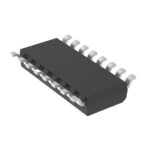 NB2309AC1D

The activity of extra discounts on wholesale prices is in full swing…
Please fill in your contact information and we will send you the latest wholesale price list.






