 ChipApex | Global Electronic Components Supplier
SEARCH
Search Product
Search Post
— IC芯片 | 连接器 | 传感器 | 被动器件 —
Search productSearch post
— IC芯片 | 连接器 | 传感器 | 被动器件 —
Consult the customer manager about the wholesale price.
consultation hotline:86-132-6715-2157
email:[email protected]
Contact the product manager for consultation. One-stop consultation is available.
Do you want a lower wholesale price? Please send us your inquiry and we will reply immediately.
The NHUMB9-QX is a dual PNP bipolar junction transistor (BJT) array from Nexperia, designed for surface-mount applications in the 6-TSSOP package. It features an 80V collector-emitter breakdown voltage and a maximum continuous collector current of 100mA per transistor. The device includes integrated base resistors to simplify circuit design, with a typical DC current gain (hFE) of 100 at 10mA and 5V. It operates within a temperature range of -55°C to +150°C and has a maximum power dissipation of 350mW. This component is qualified under AEC-Q101 standards for automotive reliability.
Verify the specific suffix 'QX' against official Nexperia documentation to confirm automotive grade status and exact pinout compatibility. Ensure that the ordering information matches the required tape and reel specifications for automated assembly processes. Cross-reference the manufacturer part number with authorized distributors to confirm current availability and authenticity before procurement.
Select this component when a dual PNP solution with built-in base resistors is required for space-constrained designs. The 6-TSSOP package offers a compact footprint suitable for dense PCB layouts. Consider the 80V rating and 100mA current capability to ensure adequate headroom for the intended load conditions. Verify that the integrated resistor values align with the target drive currents and logic levels.
This part belongs to the NHUMB9 series of pre-biased BJT arrays. The 'Q' designation typically indicates automotive qualification, while 'X' often denotes specific packaging or trailing zero variants. It serves as a complementary counterpart to NPN versions like the NHUPB9 series, providing symmetric options for push-pull or differential signaling applications in Nexperia's discrete semiconductor portfolio.
Direct substitutes include other Nexperia dual PNP pre-biased transistors in the SOT-363/6-TSSOP package such as the NHUMB9 or NHUMD9 series, provided electrical parameters match. Verify pin-to-pin compatibility and resistor values when replacing with non-Nexperia equivalents to ensure functional equivalence in existing designs.
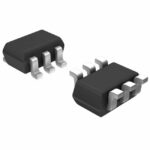 NHUMB9-QX
The activity of extra discounts on wholesale prices is in full swing…
Please fill in your contact information and we will send you the latest wholesale price list.




