 ChipApex | Global Electronic Components Supplier
SEARCH
Search Product
Search Post
— IC芯片 | 连接器 | 传感器 | 被动器件 —
Search productSearch post
— IC芯片 | 连接器 | 传感器 | 被动器件 —
Consult the customer manager about the wholesale price.
consultation hotline:86-132-6715-2157
email:[email protected]
Contact the product manager for consultation. One-stop consultation is available.
Do you want a lower wholesale price? Please send us your inquiry and we will reply immediately.
The NJM2204AD is a monolithic integrated IF limiting amplifier manufactured by Nisshinbo Micro Devices Inc. It incorporates a temperature-compensated reference power supply, a six-stage differential limiting amplifier, and a six-stage logarithmic suppression circuit. The device provides a voltage gain of 60dB and maintains linearity within ±1dB across a 50dB log dynamic range. Designed for stable operation with supply voltages ranging from 8V to 16V, it utilizes bipolar technology and is housed in a DIP-16 package.
Verify the specific suffix AD against official datasheets to confirm the package type and manufacturing revision. Confirm that the operating conditions align with the recommended limits, specifically the supply voltage range of 8V to 16V. Ensure input coupling capacitors are selected correctly for the intended intermediate frequency. Check for any RoHS compliance status updates if required for your assembly process.
Select this component when designing IF stages requiring precise signal amplitude detection over a wide dynamic range. It is suitable for applications needing a fixed 60dB gain with minimal distortion. Consider the external compensation requirements for the reference voltage to optimize temperature stability. Evaluate the DIP-16 footprint compatibility during the PCB layout phase.
This part belongs to the NJM2204A series of specialized function amplifiers produced by Nisshinbo Micro Devices Inc. The series focuses on integrated solutions for telecommunications signal processing. The NJM2204AD variant specifically denotes the dual in-line package configuration used for through-hole mounting in legacy or robust electronic designs.
Direct substitutes require matching the 60dB gain, 50dB dynamic range, and DIP-16 package. Verify pin-to-pin compatibility for all sixteen pins, including the specific RF IN, LOG OUT, and V REF terminals. Ensure the replacement supports the same 8V to 16V supply voltage range and -20°C to 85°C operating temperature.
The maximum operating frequency is specified as 3 MHz.
Linearity is defined as the error between the RF input level and an ideal straight line connecting the detection outputs at -2dBm and -52dBm input levels.
The typical operating current is 6 mA under standard test conditions.
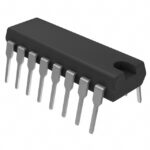 NJM2204AD
The activity of extra discounts on wholesale prices is in full swing…
Please fill in your contact information and we will send you the latest wholesale price list.





