ChipApex | Global Electronic Components Supplier

SEARCH
Search Product
Search Post
— IC芯片 | 连接器 | 传感器 | 被动器件 —
Search productSearch post
— IC芯片 | 连接器 | 传感器 | 被动器件 —
Consult the customer manager about the wholesale price.
consultation hotline:86-132-6715-2157
email:[email protected]
Contact the product manager for consultation. One-stop consultation is available.
Do you want a lower wholesale price? Please send us your inquiry and we will reply immediately.
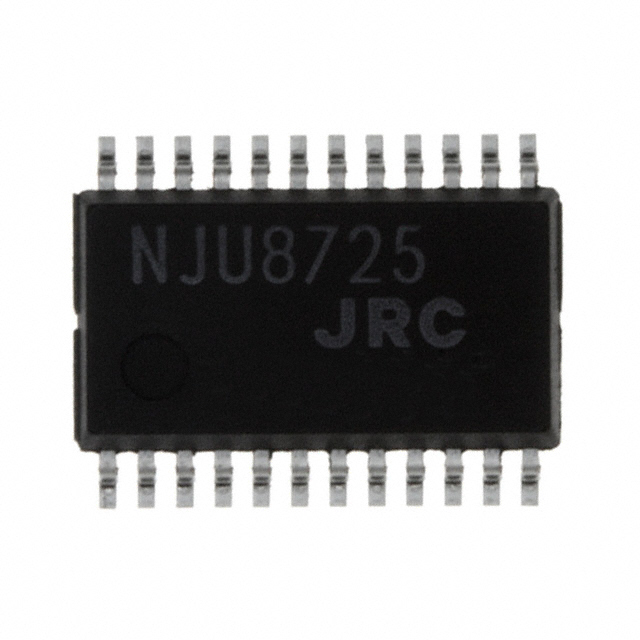
The NJU8725V-TE1 is a Class D stereo power amplifier manufactured by Nisshinbo Micro Devices Inc. It delivers an output power of 800 mW per channel into an 8 Ohm load with a total harmonic distortion plus noise of 0.1%. The device operates on a single supply voltage ranging from 3 V to 3.6 V, while the driver stage supports voltages up to 5.25 V. It features a maximum sampling frequency of 96 kHz and utilizes sixth-order delta-sigma modulation. The component is housed in an SSOP-24 package and functions within a temperature range of -40°C to +85°C.
Verify the specific ordering suffix and package type against current manufacturer documentation before procurement. Confirm availability status as distribution channels may list discontinued or limited stock items. Ensure compatibility with required serial audio interface protocols and power supply constraints during the sourcing process.
Select this component for designs requiring integrated digital signal processing capabilities alongside amplification. Consider the requirement for external LC low-pass filters to convert PWM signals to analog outputs. Evaluate the need for switching regulator power supplies to maintain THD specifications under dynamic load conditions.
This part belongs to the NJU8725 series of Class D amplifiers designed for digital audio applications. It represents a solution combining amplification with digital filtering and modulation technologies. The series targets portable and battery-operated devices where efficiency and sound quality are critical design parameters.
Public confirmed substitute part numbers are not available in the provided documentation. Verify pinout and electrical characteristics if considering alternative Class D amplifiers from other manufacturers.
If the Master Clock fluctuates significantly against the LRCK, the device detects synchronization failure and sets the attenuation value to negative infinity. Normal operation resumes when synchronization is restored.
The MODE terminal selects between Parallel Control Mode and Serial Control Mode. In parallel mode, audio format is set via F0-F2 terminals; in serial mode, it uses a three-wire interface for register control.
 NJU8725V-TE1

The activity of extra discounts on wholesale prices is in full swing…
Please fill in your contact information and we will send you the latest wholesale price list.