 ChipApex | Global Electronic Components Supplier
SEARCH
Search Product
Search Post
— IC芯片 | 连接器 | 传感器 | 被动器件 —
Search productSearch post
— IC芯片 | 连接器 | 传感器 | 被动器件 —
Consult the customer manager about the wholesale price.
consultation hotline:86-132-6715-2157
email:[email protected]
Contact the product manager for consultation. One-stop consultation is available.
Do you want a lower wholesale price? Please send us your inquiry and we will reply immediately.
The NJU8752V-TE1 is a monaural Class D amplifier designed for piezo speakers, utilizing CMOS technology. It features an analog signal input and BTL output configuration. The device operates with a control supply voltage of 2.7 to 3.6 V and an output driver supply voltage up to 16.0 V. Key electrical parameters include a voltage gain of 31 dB, an operating current of 3.5 mA (no signal), and a standby current of 1 µA. It incorporates built-in low voltage detection and short circuit protection mechanisms.
Verify the specific package variant, as the NJU8752 series includes SSOP14, QFN20, and QFN28 options. Confirm the required voltage gain specification, as the standard NJU8752 provides 31 dB while the NJU8752B variant offers 20 dB. Ensure the design accommodates the distinct input supply range requirements between these variants before finalizing procurement.
Select this component for designs requiring efficient piezo speaker drive without bulky coupling capacitors. The NJU8752V-TE1 specifically denotes the SSOP14 package version. Consider the 31 dB fixed gain suitable for moderate input levels. Evaluate the need for the integrated low voltage detector and short protector to simplify system safety requirements compared to discrete solutions.
This part belongs to the NJU8752/52B family of analog signal input Class D amplifiers manufactured by Nisshinbo Micro Devices. The series is engineered specifically for piezo transducers, offering a compact solution for monaural audio reproduction. The V-TE1 suffix indicates the SSOP14 surface-mount package configuration within this product line.
The NJU8752B is a related variant within the same family but differs in voltage gain (20 dB vs 31 dB) and minimum input supply voltage (3.1 V vs 2.7 V). Direct substitution requires verifying if the gain difference and supply constraints align with the existing circuit design.
The device includes a built-in short protector that turns off the output driver upon detecting high short-circuit currents. It typically returns to normal operation after approximately 5 seconds, though it is designed for instantaneous accidents rather than continuous shorts.
The MUTEB pin controls the mute function. Setting this pin to a low state enables mute mode, causing the output pins to output a square wave with a 50% duty cycle. A high state disables the mute function.
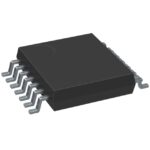 NJU8752V-TE1
The activity of extra discounts on wholesale prices is in full swing…
Please fill in your contact information and we will send you the latest wholesale price list.






