 ChipApex | Global Electronic Components Supplier

SEARCH
Search Product
Search Post
— IC芯片 | 连接器 | 传感器 | 被动器件 —
Search productSearch post
— IC芯片 | 连接器 | 传感器 | 被动器件 —
Consult the customer manager about the wholesale price.
consultation hotline:86-132-6715-2157
email:[email protected]
Contact the product manager for consultation. One-stop consultation is available.
Do you want a lower wholesale price? Please send us your inquiry and we will reply immediately.
The NL17SZ06EDFT2G is a single inverter gate from the onsemi NL17SZ series, designed for low-voltage digital applications. It operates within a supply voltage range of 1.65 V to 5.5 V and features Schmitt trigger inputs to ensure clean signal transitions. The device utilizes CMOS technology and is housed in a compact SC-88A-5 surface-mount package. Key electrical characteristics include a low-level output current of 32 mA and a high-level output current of -32 mA. Propagation delay is specified at 4.5 ns under typical conditions, supporting high-speed logic operations across an industrial temperature range of -55°C to +125°C.
Verify the specific suffix 'E' against the manufacturer's official datasheet to confirm pinout and electrical tolerances, as suffixes often denote specific tape-and-reel or reliability grades. Confirm RoHS compliance status directly with the supplier documentation. Ensure the SC-88A-5 package dimensions match your PCB land pattern requirements before finalizing procurement orders.
Select this component when a single inverter with Schmitt trigger functionality is required in a minimal footprint. It is suitable for replacing older logic families that lack hysteresis. Consider the 1.65 V minimum supply voltage for battery-powered applications. Verify that the 32 mA drive capability meets the load requirements of the downstream circuitry without exceeding power dissipation limits.
This part belongs to the NL17SZ family of single-function gates from onsemi. The series focuses on low-voltage, high-speed performance in small packages. Similar parts in the lineup include non-inverting buffers and other logic gates like NOR or AND functions, all sharing the same SC-88A-5 package and voltage specifications for modular design flexibility.
Check for direct equivalents such as the NL17SZ06DFT2G if the Schmitt trigger feature is not strictly required. Verify pin-to-pin compatibility with other single inverters in the SC-88A-5 package from different manufacturers. Ensure that propagation delay and output current specifications meet or exceed the original design requirements.
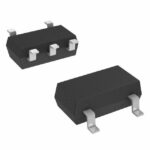 NL17SZ06EDFT2G

The activity of extra discounts on wholesale prices is in full swing…
Please fill in your contact information and we will send you the latest wholesale price list.





