 ChipApex | Global Electronic Components Supplier

SEARCH
Search Product
Search Post
— IC芯片 | 连接器 | 传感器 | 被动器件 —
Search productSearch post
— IC芯片 | 连接器 | 传感器 | 被动器件 —
Consult the customer manager about the wholesale price.
consultation hotline:86-132-6715-2157
email:[email protected]
Contact the product manager for consultation. One-stop consultation is available.
Do you want a lower wholesale price? Please send us your inquiry and we will reply immediately.
The NLU1GT04BMX1TCG is a single-channel inverter from the onsemi NLU logic series, housed in a compact 6-pin ULLGA package measuring 1 x 1 x 0.35 mm. It operates within a supply voltage range of 1.65 V to 5.5 V and supports Schmitt trigger inputs for noise immunity. The device features single-ended input and output configurations with non-inverting polarity logic implementation. Key electrical parameters include a maximum high-level output current of -8 mA and a low-level output current of 8 mA. Propagation delay is specified at 25.5 ns under a 50 pF load condition. The component is rated for operation between -55 °C and +125 °C.
Verify the specific suffix 'BMX1TCG' against official onsemi documentation to confirm exact tape-and-reel specifications and environmental compliance status. Ensure the ordering part number matches the required package variant and temperature grade. Cross-reference with the latest datasheet revision to validate pinout and electrical characteristics before finalizing procurement orders.
Select this component when space constraints require a minimal footprint solution for single-channel inversion. The wide voltage range allows compatibility with various logic families. Verify that the 25.5 ns propagation delay meets system timing requirements. Confirm that the 6-pin ULLGA package is suitable for the intended PCB assembly process and thermal management needs.
This part belongs to the NLU series of ultra-low power logic devices designed for mobile and handheld applications. The series emphasizes miniaturization and energy efficiency. The NLU1GT04BMX1TCG specifically provides inverter functionality within this family, utilizing CMOS technology to achieve low static power consumption while maintaining robust signal integrity in compact form factors.
Check for direct cross-reference part numbers from onsemi or other manufacturers offering identical 6-ULLGA inverter specifications. Ensure replacement parts match the 1.65 V to 5.5 V operating range and Schmitt trigger input requirements. Verify package dimensions and pinout compatibility to avoid PCB redesign.
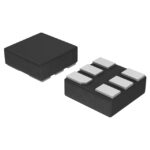 NLU1GT04BMX1TCG

The activity of extra discounts on wholesale prices is in full swing…
Please fill in your contact information and we will send you the latest wholesale price list.





