 ChipApex | Global Electronic Components Supplier
SEARCH
Search Product
Search Post
— IC芯片 | 连接器 | 传感器 | 被动器件 —
Search productSearch post
— IC芯片 | 连接器 | 传感器 | 被动器件 —
Consult the customer manager about the wholesale price.
consultation hotline:86-132-6715-2157
email:[email protected]
Contact the product manager for consultation. One-stop consultation is available.
Do you want a lower wholesale price? Please send us your inquiry and we will reply immediately.
The NSBC124EPDXV6T5 is a dual digital transistor array manufactured by onsemi, housed in an SOT-563 surface-mount package. It integrates one NPN and one PNP pre-biased bipolar junction transistor within a single compact component. The device supports a maximum collector-emitter voltage of 50 V and a continuous collector current of 100 mA. Internal base resistors are typically 22 kOhms for both transistors, with a resistance ratio of 1. The unit offers a minimum DC current gain (hFE) of 60 at specified test conditions and handles a power dissipation of up to 500 mW. It operates reliably across a temperature range from -55°C to +150°C.
Verify the specific suffix 'T5' against official manufacturer documentation to confirm tape-and-reel specifications and availability status. Cross-reference with the 'T1G' variant if RoHS compliance or updated manufacturing lines are required, as suffixes often denote packaging or environmental compliance differences rather than functional changes.
Select this component when a matched NPN/PNP pair with fixed internal biasing is needed to reduce external resistor count. Ensure the 50V voltage rating and 100mA current limit align with the load requirements. Verify that the 22kOhm internal base resistance provides appropriate drive current for the intended application without exceeding the controller's output capability.
This part belongs to the NSBC124 series of dual digital transistors from onsemi. It is functionally similar to other members like the NSBC124EPDXV6T1G but may differ in packaging format or production lifecycle status. The EPDXV6 designation indicates the specific pinout and physical dimensions associated with the SOT-563 package type used in modern surface-mount assembly processes.
The NSBC124EPDXV6T1G is listed as a direct substitute in public records. Verify electrical parameter equivalence and package compatibility before replacement. Other compatible parts in the NSBC124 family should be evaluated based on specific resistor values and polarity configurations.
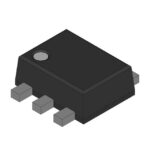 NSBC124EPDXV6T5
The activity of extra discounts on wholesale prices is in full swing…
Please fill in your contact information and we will send you the latest wholesale price list.




