ChipApex | Global Electronic Components Supplier
SEARCH
Search Product
Search Post
— IC芯片 | 连接器 | 传感器 | 被动器件 —
Search productSearch post
— IC芯片 | 连接器 | 传感器 | 被动器件 —
Consult the customer manager about the wholesale price.
consultation hotline:86-132-6715-2157
email:[email protected]
Contact the product manager for consultation. One-stop consultation is available.
Do you want a lower wholesale price? Please send us your inquiry and we will reply immediately.
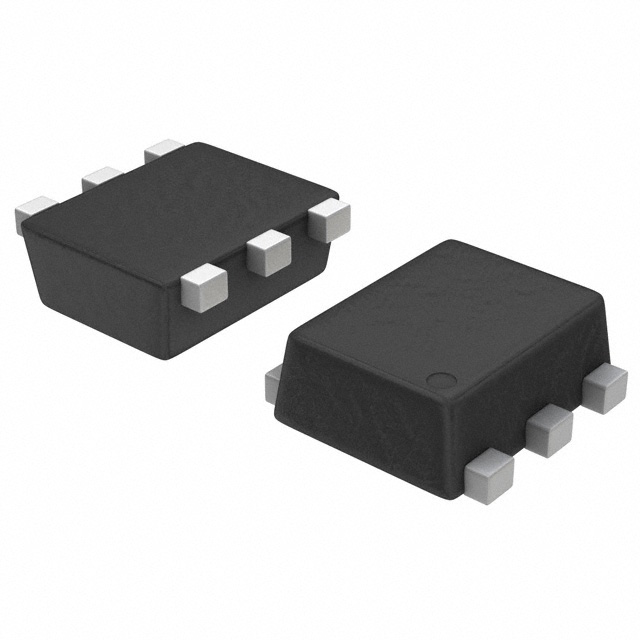
The NSBC144EDP6T5G is a dual NPN Bias Resistor Transistor (BRT) from onsemi, housed in an SOT-963 package. It integrates two NPN transistors with monolithic bias resistor networks, replacing discrete components to reduce board space and system cost. The device features a collector-emitter voltage of 50 Vdc and continuous collector current of 100 mAdc. Each channel includes a series base resistor (R1) of 47 kOhms and a base-emitter resistor (R2) of 47 kOhms. It operates within a junction temperature range of -55°C to +150°C and meets AEC-Q101 qualification standards for automotive applications.
Verify the specific ordering suffix P6 corresponds to the SOT-963 package configuration before procurement. Confirm that the required quantity aligns with the standard shipping unit of 8,000 units per tape and reel. Ensure compliance with RoHS and halogen-free material specifications if mandated by the end-product regulations. Validate that the AEC-Q101 qualification status satisfies the quality requirements for the intended application environment.
Select this component when a compact dual NPN solution with integrated biasing is required. The 47 kOhm resistor values are suitable for standard logic interface applications. Consider the thermal dissipation characteristics of the SOT-963 package relative to the expected power load. Verify that the 50 V collector-emitter voltage rating exceeds the maximum operating voltage of the target circuit.
This part belongs to the DTC144ED series of dual NPN bias resistor transistors. It shares functional similarities with the MUN5213DW1 and NSBC144EDXV6 but utilizes the distinct SOT-963 package format. The series is designed to simplify circuit designs by consolidating transistor and resistor functions into a single surface-mount device.
Direct substitutes include the MUN5213DW1T1G and NSBC144EDXV6T1G. These alternatives offer identical electrical characteristics but utilize different package types such as SOT-363 or SOT-563. Verify pin compatibility and thermal performance differences when substituting across package formats.
 NSBC144EDP6T5G
The activity of extra discounts on wholesale prices is in full swing…
Please fill in your contact information and we will send you the latest wholesale price list.