 ChipApex | Global Electronic Components Supplier
SEARCH
Search Product
Search Post
— IC芯片 | 连接器 | 传感器 | 被动器件 —
Search productSearch post
— IC芯片 | 连接器 | 传感器 | 被动器件 —
Consult the customer manager about the wholesale price.
consultation hotline:86-132-6715-2157
email:[email protected]
Contact the product manager for consultation. One-stop consultation is available.
Do you want a lower wholesale price? Please send us your inquiry and we will reply immediately.
The NSBC144EPDXV6T1G is a complementary Bias Resistor Transistor (BRT) from onsemi, integrating an NPN and a PNP transistor with monolithic bias resistor networks into a single SOT-563-6 package. Designed to replace discrete devices and external resistors, it simplifies circuit design while reducing board space and component count. The device features a typical input resistance of 47 kΩ for both transistors, with a collector-emitter maximum voltage of 50 Vdc and continuous collector current of 100 mAdc. It operates within a junction temperature range of -55°C to +150°C and offers a total device dissipation of 357 mW when one junction is heated.
Verify the specific ordering suffix to confirm packaging quantity and shipping format, as variations exist within the series. Confirm RoHS compliance status and Pb-Free designation during procurement. Ensure the selected variant matches the required thermal characteristics and pin configuration for the target application. Cross-reference the latest datasheet revision to account for any electrical characteristic updates or discontinuation notices.
Select this component when a complementary pair of NPN and PNP digital transistors with integrated biasing is required in a compact surface-mount package. Consider the 47 kΩ input resistance value for base drive compatibility. Evaluate the thermal dissipation limits relative to the expected operating conditions and PCB copper area. Verify that the 50 V collector-emitter voltage rating meets the circuit's maximum voltage requirements.
This part belongs to the NSBC144EPDXV6 series of complementary BRTs manufactured by onsemi. It shares functional similarities with other devices in the DTC144EP family but is distinguished by its specific SOT-563-6 packaging and internal resistor values. The series includes variants with different shipping quantities and automotive qualifications, such as the NSV prefix.
Direct substitutes include MUN5313DW1T1G in SOT-363 and NSBC144EPDP6T5G in SOT-963, though package dimensions differ. Verify pinout compatibility and thermal performance before substitution. Check for updated equivalents if the current part is discontinued or if alternative resistor ratios are needed.
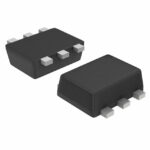 NSBC144EPDXV6T1G
The activity of extra discounts on wholesale prices is in full swing…
Please fill in your contact information and we will send you the latest wholesale price list.




