ChipApex | Global Electronic Components Supplier

SEARCH
Search Product
Search Post
— IC芯片 | 连接器 | 传感器 | 被动器件 —
Search productSearch post
— IC芯片 | 连接器 | 传感器 | 被动器件 —
Consult the customer manager about the wholesale price.
consultation hotline:86-132-6715-2157
email:[email protected]
Contact the product manager for consultation. One-stop consultation is available.
Do you want a lower wholesale price? Please send us your inquiry and we will reply immediately.
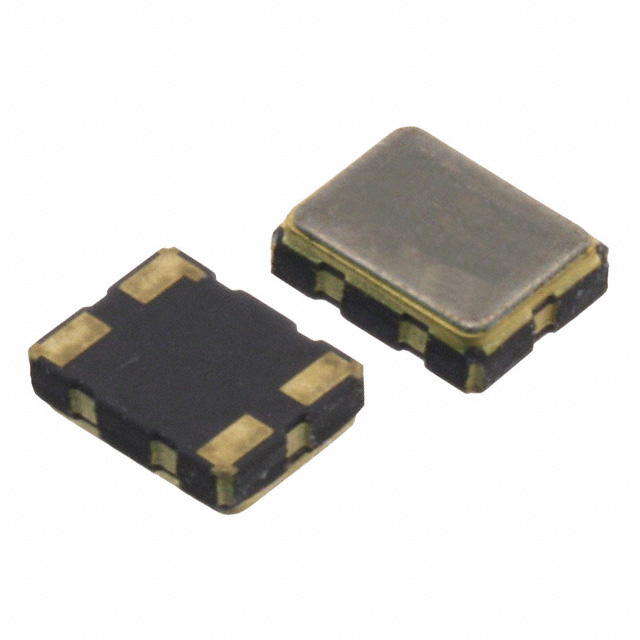
The NT3225SA-52.000000MHZ-S1 is a Temperature Compensated Crystal Oscillator (TCXO) manufactured by NDK. It operates at a nominal frequency of 52 MHz with a clipped sine wave output. The device supports low supply voltages, specifically DC +1.8V and +3.0V, within a range of +1.7V to +3.3V. It features a compact 4-SMD, No Lead package measuring 3.2mm x 2.5mm x 1.0mm maximum height. Key electrical specifications include a load capacitance of 10 kΩ // 10 pF, an output voltage swing of minimum 0.8 V(p-p), and a frequency stability of ±2.5 ppm over the operating temperature range of -30°C to +75°C.
Verify that the specific suffix 'S1' corresponds to the required output waveform and pin configuration, as distributor listings may vary in descriptive accuracy. Confirm the supply voltage requirement matches your system design, noting the standard specifications are typically +1.8V or +3.0V. Ensure the PCB footprint aligns with the 4-SMD no-lead package dimensions of 3.2mm x 2.5mm. Check RoHS compliance status if environmental regulations apply to your manufacturing process.
Select this component when high frequency stability is critical in space-constrained portable applications. The TCXO technology offers superior performance compared to standard crystals without requiring external compensation circuits. Consider the 52 MHz frequency for specific clocking needs in wireless standards. Evaluate the low voltage compatibility against your power management architecture. The compact form factor makes it suitable for dense circuit board layouts in modern consumer electronics.
This oscillator belongs to the NT3225SA series, designed for mobile and wireless applications. NDK manufactures these components to meet the demands of miniaturization and power efficiency in modern electronics. The series is widely used in smartphones and GPS modules where size and stability are paramount. NDK's focus on quartz crystal devices ensures reliable oscillation sources for networked societies.
Public confirmed substitute part numbers are not available in the provided documentation. Consult NDK technical support for direct equivalents or cross-reference options based on specific electrical requirements.
 NT3225SA-52.000000MHZ-S1

The activity of extra discounts on wholesale prices is in full swing…
Please fill in your contact information and we will send you the latest wholesale price list.