 ChipApex | Global Electronic Components Supplier
SEARCH
Search Product
Search Post
— IC芯片 | 连接器 | 传感器 | 被动器件 —
Search productSearch post
— IC芯片 | 连接器 | 传感器 | 被动器件 —
Consult the customer manager about the wholesale price.
consultation hotline:86-132-6715-2157
email:[email protected]
Contact the product manager for consultation. One-stop consultation is available.
Do you want a lower wholesale price? Please send us your inquiry and we will reply immediately.
The NX3V1T384GM,115 is a single-pole double-throw (SPDT) analog switch manufactured by NXP Semiconductors. It operates within a supply voltage range of 1.4 V to 4.3 V and features an ultra-low on-resistance of typically 0.25 Ω at 4.3 V. The device supports bidirectional signal transmission with amplitudes up to the supply voltage. It includes Schmitt trigger action at the enable input for noise immunity and offers high ESD protection exceeding 7500 V via HBM. The component is available in an 8-XQFNU package measuring 1.6x1.6 mm and is specified for operation from -40 °C to +125 °C.
Verify the specific ordering suffix against official NXP documentation to confirm package type and tape-and-reel specifications. Ensure compliance with RoHS directives and REACH regulations as stated in the manufacturer's environmental declarations. Confirm availability status directly with authorized distributors, as production lifecycles may change without prior notice.
Select this component when designing circuits that require low insertion loss and high-speed switching within a small footprint. The wide supply voltage range accommodates various logic levels, while the robust ESD protection safeguards sensitive downstream components. Verify that the thermal performance meets the requirements for the intended operating temperature range.
This part belongs to the NX3V series of low-ohmic analog switches designed for portable applications. It shares functional similarities with other members like the NX3V1G384 but differs in configuration and pinout. The series emphasizes low power consumption and high current handling capabilities suitable for modern mobile and battery-operated devices.
Check for direct pin-compatible alternatives within the NX3V family, such as the NX3V1G384, ensuring electrical parameters match the design requirements. Verify package dimensions and thermal characteristics before substitution to maintain board layout integrity.
The device supports a continuous current of 500 mA under a 3.3 V supply condition.
Yes, the control input accepts voltages above the supply voltage, facilitating direct interface with higher voltage logic levels.
The typical on-resistance is 0.25 Ω when the supply voltage is 4.3 V.
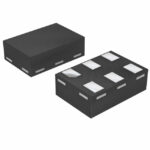 NX3V1T384GM,115
The activity of extra discounts on wholesale prices is in full swing…
Please fill in your contact information and we will send you the latest wholesale price list.





