 ChipApex | Global Electronic Components Supplier
SEARCH
Search Product
Search Post
— IC芯片 | 连接器 | 传感器 | 被动器件 —
Search productSearch post
— IC芯片 | 连接器 | 传感器 | 被动器件 —
Consult the customer manager about the wholesale price.
consultation hotline:86-132-6715-2157
email:[email protected]
Contact the product manager for consultation. One-stop consultation is available.
Do you want a lower wholesale price? Please send us your inquiry and we will reply immediately.
The PBLS1502V is a 15 V PNP BISS loadswitch featuring a low VCEsat PNP transistor and an NPN resistor-equipped transistor in one package. It operates with a collector-emitter voltage of -15 V for the PNP section and up to 50 V for the NPN section. The device supports a DC collector current of -500 mA for the PNP and 100 mA for the NPN. Key electrical parameters include an equivalent on-resistance (RCEsat) of 300 mΩ typical at -500 mA, and a bias resistor R1 of 4.7 kΩ typical. It is housed in a SOT666 plastic surface-mounted package.
Verify the specific ordering suffix matches the required package type, as PBLS1502V denotes the SOT666 package while PBLS1502Y uses SOT363. Confirm availability status through official NXP channels, as product lifecycles may change. Ensure compliance with RoHS and halogen-free requirements if specified for your application. Check for any recent revision updates to the datasheet before finalizing designs.
Select the PBLS1502V when a combined high-side switch and logic-level translation or control function is needed in a small footprint. The integrated NPN transistor with bias resistor simplifies driving the PNP load switch. Consider the thermal resistance of 416 K/W and the 200 mW per-device power dissipation limit for thermal management. Ensure the input voltage levels are compatible with the NPN transistor's characteristics.
This component belongs to NXP's discrete transistor portfolio, specifically designed as a BISS (Bipolar Integrated Switch Solution) loadswitch. It integrates two transistors to provide efficient switching capabilities. The PBLS1502V variant specifically utilizes the SOT666 package, distinguishing it from the SOT363 packaged PBLS1502Y. It is part of a series aimed at reducing board space and component count in power management applications.
PBLS1502Y is a direct functional substitute with identical electrical specifications but differs in packaging (SOT363 vs. SOT666). Verify pinout compatibility and physical footprint constraints before swapping between these variants. No other cross-model substitutes are documented in the provided source material.
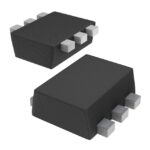 PBLS1502V,115
The activity of extra discounts on wholesale prices is in full swing…
Please fill in your contact information and we will send you the latest wholesale price list.




