 ChipApex | Global Electronic Components Supplier

SEARCH
Search Product
Search Post
— IC芯片 | 连接器 | 传感器 | 被动器件 —
Search productSearch post
— IC芯片 | 连接器 | 传感器 | 被动器件 —
Consult the customer manager about the wholesale price.
consultation hotline:86-132-6715-2157
email:[email protected]
Contact the product manager for consultation. One-stop consultation is available.
Do you want a lower wholesale price? Please send us your inquiry and we will reply immediately.
The PCA9553D/02,112 is an LED blinker IC manufactured by NXP USA Inc., designed for I²C-bus and SMBus applications. It features four open-drain outputs capable of sinking up to 25 mA per bit and 100 mA per package. The device includes an internal oscillator providing two programmable blink rates with adjustable frequency and duty cycle. It operates within a supply voltage range of 2.3 V to 5.5 V and supports clock frequencies up to 400 kHz. The component is housed in an 8-TSSOP package and functions as both an LED driver and general-purpose GPIO expander.
Verify the specific suffix '02' against official NXP documentation to confirm the fixed I²C address configuration, as it differs from other variants like '01'. Confirm current manufacturing status and availability through authorized distributors, as lead times may vary. Ensure the 8-TSSOP package orientation matches your PCB footprint requirements before ordering.
Select this component when minimizing I²C bus load is critical compared to standard GPIO expanders. It is suitable for applications requiring hardware-controlled LED blinking at specific frequencies. Consider the 25 mA sink capability per channel for direct LED driving. Verify compatibility with the system's I²C address space, as this variant uses a distinct fixed address.
This part belongs to the PCA9553 family of LED blinkers from NXP Semiconductors. Unlike standard I/O expanders such as the PCF8574, it integrates timing functionality internally. The 'D' indicates an SOIC-8 package variant, while '/02' specifies the unique I²C address configuration for bus multiplexing alongside other PCA9553 variants.
PCA9553DP/01,118: Parameter equivalent alternative available from Rochester Electronics, LLC. Note that the '/01' suffix denotes a different fixed I²C address than the '/02' variant; verify address compatibility if substituting on the same bus.
It requires only initial setup commands to program blink rates. Subsequent LED toggling is handled internally by the oscillator, eliminating the need for repeated bus commands from the controller.
Each individual output can sink up to 25 mA, with a total package limit of 100 mA across all channels.
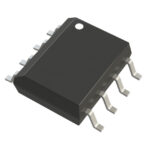 PCA9553D/02,112

The activity of extra discounts on wholesale prices is in full swing…
Please fill in your contact information and we will send you the latest wholesale price list.





