 ChipApex | Global Electronic Components Supplier
SEARCH
Search Product
Search Post
— IC芯片 | 连接器 | 传感器 | 被动器件 —
Search productSearch post
— IC芯片 | 连接器 | 传感器 | 被动器件 —
Consult the customer manager about the wholesale price.
consultation hotline:86-132-6715-2157
email:[email protected]
Contact the product manager for consultation. One-stop consultation is available.
Do you want a lower wholesale price? Please send us your inquiry and we will reply immediately.
The PCA9629APWJ is an Fm+ I²C-Bus Advanced Stepper Motor Controller manufactured by NXP Semiconductors. It is a low-power CMOS device providing all logic and control required to drive four-phase stepper motors when used with external high-current drivers. The IC supports single-phase (wave drive), two-phase, and half-stepping modes. It features four general-purpose I/O pins that can sense logic-level outputs from optical interrupt modules to generate active-low interrupts on the INT pin, enabling automatic motor stop or direction reversal. The device includes a programmable step rate ranging from 344.8 kpps to 0.3 pps with ±5% accuracy, programmable ramp start/stop, and a built-in oscillator. It operates within a temperature range of -40°C to +85°C and utilizes a 16-TSSOP package.
Verify the specific suffix 'APWJ' against the official NXP datasheet to confirm package type and tape/reel specifications. Ensure compatibility with the target system's I²C bus voltage levels and current requirements for external drivers. Confirm operating temperature range alignment with environmental conditions. Cross-reference part numbers with authorized distributors to avoid counterfeit components.
Select this component when CPU offloading for stepper motor control is required. It is suitable for applications needing precise step rate programming and ramp control without continuous MCU intervention. Consider its GPIO interrupt functionality for closed-loop position sensing needs. Evaluate the need for external high-current drivers based on motor coil specifications.
The PCA9629 belongs to NXP's family of I²C-bus controlled peripheral devices designed for motor control and system management. It complements microcontrollers by handling real-time timing and sequencing tasks, allowing the main processor to focus on higher-level application logic. This integration simplifies hardware design by reducing the number of required GPIO pins and complex timing circuits.
Check NXP documentation for direct cross-references. Verify if alternative stepper motor controllers offer compatible I²C interfaces and similar GPIO interrupt functionalities. Ensure any substitute supports the required stepping modes and operating temperature range.
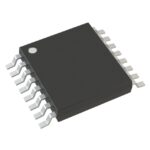 PCA9629APWJ
The activity of extra discounts on wholesale prices is in full swing…
Please fill in your contact information and we will send you the latest wholesale price list.





