 ChipApex | Global Electronic Components Supplier

SEARCH
Search Product
Search Post
Search productSearch post
Consult the customer manager about the wholesale price.
consultation hotline:86-132-6715-2157
email:[email protected]
Contact the product manager for consultation. One-stop consultation is available.
Do you want a lower wholesale price? Please send us your inquiry and we will reply immediately.
PCK2001RDB,118 is listed in the Clock Buffers, Drivers range at ChipApex. The manufacturer field lists NXP USA Inc. Its product description is IC CLK BUFFER 1:6 533MHZ 16SSOP. Review the specifications below when checking this part for your BOM.
The PCK2001RDB,118 is a 533 MHz I2C-controlled 1:6 clock buffer manufactured by NXP USA Inc. (formerly Philips Semiconductors). It operates on a single 3.3 V supply and features six buffered clock outputs designed for high-speed signal distribution. The device supports frequencies up to 533 MHz, with optimized performance at 33, 66, 100, and 133 MHz. Key electrical parameters include a typical propagation delay of 2.5 ns, rise/fall times of 1.0 ns/700 ps, and part-to-part skew under 500 ps. It utilizes an I2C interface for individual output enable/disable control and is housed in a 16-pin SSOP package.
Verify the component status as product data from Philips Semiconductors dated December 2002. Confirm that the 16-pin SSOP package matches the SOT369-1 drawing number. Ensure the operating temperature range of 0°C to +70°C aligns with system requirements. Check for any specific revision history updates regarding the increase of Fmax to 533 MHz.
Select this component when a 1:6 fanout buffer is required for high-frequency clock signals up to 533 MHz. It is suitable for designs needing individual output control via I2C. Compare with the PCK2001 (48-pin, 1:18) or PCK2001M (28-pin, 1:10) if different fanout ratios are needed. Ensure the design accommodates the 3.3 V logic levels and I2C pull-up resistor requirements.
The PCK2001R is part of the PCK2001 family of clock buffers. It serves as a lower-pin-count alternative to the PCK2001 (48-pin, 1:18 fanout) and the PCK2001M (28-pin, 1:10 fanout). This specific variant provides a 1:6 fanout ratio, making it ideal for supporting up to four registered SDRAM DIMMs in server architectures.
Direct replacements within the same family include the PCK2001 (48-pin, 1:18) and PCK2001M (28-pin, 1:10), though pinouts and fanout ratios differ. Verify compatibility with existing PCB layouts and software I2C configurations when substituting these variants.
The PCK2001R supports an operating frequency of up to 533 MHz.
The device provides six buffered clock outputs (BUF_OUT0 through BUF_OUT17).
Yes, each of the six outputs can be individually enabled or disabled via the I2C serial interface.
The part-to-part skew is typically 175 ps, with a maximum specification of less than 500 ps.
Explore related parts through Clock/Timing, Integrated Circuits (ICs), all product categories, ChipApex homepage.
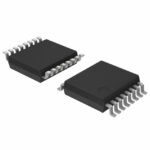 PCK2001RDB,118

The activity of extra discounts on wholesale prices is in full swing…
Please fill in your contact information and we will send you the latest wholesale price list.




