 ChipApex | Global Electronic Components Supplier
SEARCH
Search Product
Search Post
— IC芯片 | 连接器 | 传感器 | 被动器件 —
Search productSearch post
— IC芯片 | 连接器 | 传感器 | 被动器件 —
Consult the customer manager about the wholesale price.
consultation hotline:86-132-6715-2157
email:[email protected]
Contact the product manager for consultation. One-stop consultation is available.
Do you want a lower wholesale price? Please send us your inquiry and we will reply immediately.
The PD81000-028101 is a Power over Ethernet (PoE) Powered Device (PD) controller manufactured by Microchip Technology. It integrates a high-efficiency synchronous rectifier and a microcontroller unit (MCU) to manage power delivery and device communication. The component supports IEEE 802.3bt Type 4 standards, enabling power consumption up to 90W. It features an integrated 32-bit MCU for application logic, reducing external component count. The device operates within a specified voltage range and includes protection mechanisms against over-voltage, over-current, and thermal conditions. It is housed in a compact 32-TFQFN package with an exposed pad for enhanced thermal performance.
Verify the specific suffix code to ensure compatibility with required firmware versions and regulatory certifications. Confirm that the ordering part number matches the exact pinout and thermal requirements of your PCB layout. Check for RoHS compliance status as indicated in the official datasheet. Ensure sourcing from authorized distributors to guarantee authenticity and traceability of the semiconductor components.
Select this component when designing PoE PDs requiring integrated control and power conversion in a small footprint. It is suitable for applications needing high power efficiency and reduced bill of materials due to the integrated MCU. Consider the thermal dissipation capabilities of the TFQFN package during PCB layout. Evaluate the software development tools provided by Microchip for programming the embedded MCU.
The PD81000 series belongs to Microchip's portfolio of PoE controllers designed for modern networking infrastructure. This specific variant combines power management and processing capabilities, addressing the trend toward smarter, higher-power edge devices. It replaces discrete solutions that previously required separate controllers and MCUs, simplifying system architecture and improving reliability in dense network environments.
Consult Microchip's official cross-reference documentation for verified substitutes. Ensure any replacement maintains IEEE 802.3bt Type 4 support and compatible pin configurations. Verify that alternative components offer similar thermal performance and integrated MCU specifications to avoid redesigning the host system.
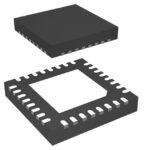 PD81000-028101
The activity of extra discounts on wholesale prices is in full swing…
Please fill in your contact information and we will send you the latest wholesale price list.






