ChipApex | Global Electronic Components Supplier
SEARCH
Search Product
Search Post
— IC芯片 | 连接器 | 传感器 | 被动器件 —
Search productSearch post
— IC芯片 | 连接器 | 传感器 | 被动器件 —
Consult the customer manager about the wholesale price.
consultation hotline:86-132-6715-2157
email:[email protected]
Contact the product manager for consultation. One-stop consultation is available.
Do you want a lower wholesale price? Please send us your inquiry and we will reply immediately.
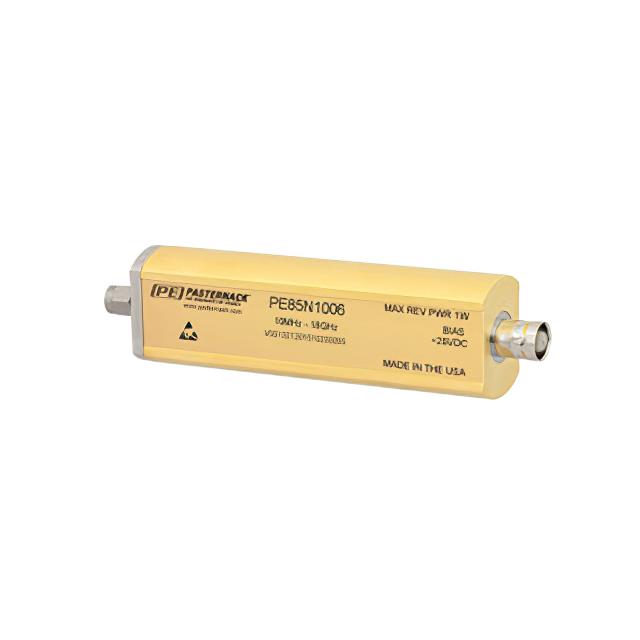
The PE85N1006 is a precision calibrated noise source module manufactured by Pasternack. It operates within a frequency range of 10 MHz to 18 GHz and utilizes SMA connectors for interface. The device provides a nominal excess noise ratio (ENR) output of 15 dB across its bandwidth. Calibration frequencies are defined at 1 GHz intervals. The unit requires a +28 VDC power supply for operation and features chassis mounting capabilities. It is designed for radar applications and supports 50 Ohm impedance systems.
Verify the specific calibration certificate and ENR tolerance values against the official datasheet prior to purchase, as accuracy specifications may vary by production lot. Confirm that the required +28 VDC power supply matches the module's electrical requirements. Ensure the SMA connector gender and polarity align with the existing test setup infrastructure to prevent interface mismatches during integration.
Select this model when a broadband noise source covering up to 18 GHz is required for high-frequency testing. Compare the 15 dB ENR specification against other models like the PE85N1003 or PE85N1007 if higher or lower noise power is needed. Consider the physical chassis mount form factor if space constraints differ from panel-mount alternatives. Validate that the 1 GHz step calibration points meet the resolution requirements of the intended measurement application.
This component belongs to the Pasternack calibrated RF noise source generator series. It serves as a standard reference signal source for electronic test and measurement equipment. The product line includes various models differentiated by frequency range and ENR output levels. These modules are essential tools for characterizing the noise performance of amplifiers, mixers, and receivers in wireless and radar industries.
The PE85N1003 offers a similar function but covers a narrower 10 MHz to 6 GHz range with a higher 26 dB ENR. The PE85N1007 extends the frequency range to 26 GHz. Verify that the alternative model's frequency coverage and ENR specifications adequately support the specific test requirements before substitution.
 PE85N1006
The activity of extra discounts on wholesale prices is in full swing…
Please fill in your contact information and we will send you the latest wholesale price list.