ChipApex | Global Electronic Components Supplier
SEARCH
Search Product
Search Post
— IC芯片 | 连接器 | 传感器 | 被动器件 —
Search productSearch post
— IC芯片 | 连接器 | 传感器 | 被动器件 —
Consult the customer manager about the wholesale price.
consultation hotline:86-132-6715-2157
email:[email protected]
Contact the product manager for consultation. One-stop consultation is available.
Do you want a lower wholesale price? Please send us your inquiry and we will reply immediately.
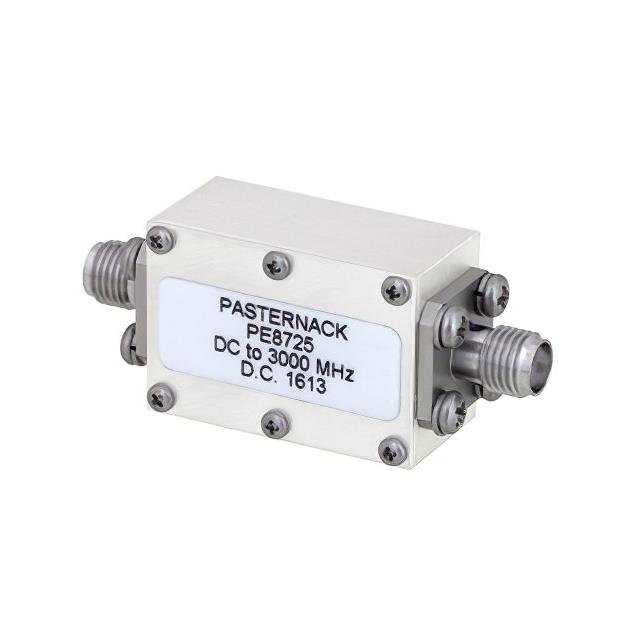
The PE8725 is a five-section low-pass filter manufactured by Pasternack, designed for signal conditioning applications. It operates from DC to 3 GHz with a characteristic impedance of 50 Ohms. The device features SMA female connectors and maintains an insertion loss of 1 dB. It supports a maximum power handling capacity of 10 Watts and exhibits an input VSWR of 1.5:1. Constructed as a standalone RF module, it weighs approximately 6.427 grams.
Verify the specific connector gender and impedance requirements against system specifications before procurement. Confirm that the 10 Watt power rating aligns with operational limits. Ensure SMA compatibility with existing cabling infrastructure. Check for RoHS compliance documentation if required by regulatory standards. Validate the 50 Ohm impedance matches the transmission line characteristics.
Select this component when a five-section topology is required for steep roll-off characteristics within the 3 GHz bandwidth. Consider the physical dimensions and weight constraints for enclosure integration. Evaluate the 1 dB insertion loss impact on overall system gain. Ensure the SMA interface suits the available connection hardware. Assess thermal management needs relative to the 10 Watt power handling capability.
This part belongs to the Pasternack RF Coaxial Filters series, specifically categorized under Signal Conditioning products. It is distinct from higher-order filters or different impedance variants within the manufacturer's lineup. The five-section architecture provides a balance between attenuation performance and physical size compared to simpler designs.
No public confirmed substitute part numbers are available for direct replacement. Verify electrical parameters such as cutoff frequency, insertion loss, and power handling when evaluating alternative components. Ensure mechanical compatibility with existing mounting structures and connector interfaces.
The PE8725 supports a maximum power handling capacity of 10 Watts.
Yes, the operating frequency range starts from DC, allowing DC signals to pass through the filter.
 PE8725
The activity of extra discounts on wholesale prices is in full swing…
Please fill in your contact information and we will send you the latest wholesale price list.